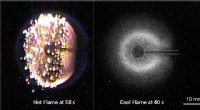
*A new study has revealed the limits of how runny a liquid can be.*
The research, published in the journal Nature, found that the thinnest possible liquid is one that is made up of tiny particles that are constantly moving and colliding with each other. This type of liquid is known as a superfluid.
Superfluids are incredibly rare and only occur in certain materials at very low temperatures. However, the new study has shown that superfluidity is not limited to these extreme conditions. In fact, superfluids can exist in a much wider range of materials and temperatures than previously thought.
The discovery could have important implications for a number of fields, including physics, materials science, and engineering. For example, superfluids could be used to create new types of ultra-efficient energy transport systems or to develop new materials with unique properties.
How the Study Was Conducted
The researchers conducted a series of experiments on a variety of different materials, including helium, hydrogen, and rubidium. They used a technique called Raman spectroscopy to measure the viscosity of the materials, which is a measure of how resistant they are to flow.
The results showed that the viscosity of the materials decreased as the temperature was lowered. At very low temperatures, the materials became superfluids and their viscosity dropped to zero.
The Implications of the Study
The discovery that superfluidity is not limited to extreme conditions could have a number of important implications. For example, superfluids could be used to:
* Create new types of ultra-efficient energy transport systems. Superfluids can flow without any resistance, so they could be used to transport energy over long distances with very little loss.
* Develop new materials with unique properties. Superfluids have a number of unusual properties, such as the ability to flow through tiny pores and to form droplets that are perfectly round. These properties could be used to create new materials with unique applications.
* Understand the fundamental nature of matter. The study of superfluids could help us to better understand the fundamental nature of matter and how it behaves at very low temperatures.
The discovery of just how runny a liquid can be is a significant breakthrough that could have a number of important implications for science and technology.