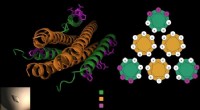
Carboxysomes are polyhedral protein shells that encapsulate enzymes that fix carbon dioxide into organic compounds. This process, known as carbon fixation, is essential for the production of food, oxygen, and other organic molecules that support life on Earth.
The research team found that carboxysomes are assembled from a single protein, called CcmA, which self-assembles into a hollow sphere. The CcmA protein then recruits other proteins, called Rubisco and carbonic anhydrase, into the carboxysome. Rubisco is the enzyme that fixes carbon dioxide, while carbonic anhydrase helps to convert carbon dioxide into bicarbonate, which can be used by Rubisco.
The discovery of the structure of the carboxysome provides new insights into how bacteria build this essential carbon-fixing machinery. This information could lead to the development of new methods to improve the efficiency of photosynthesis and carbon fixation, which could have a major impact on food production and climate change.
The research team's findings were published in the journal Nature.