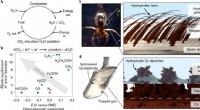
In a recent study, researchers used advanced techniques to confine electrons and ions within nanoscale regions, effectively creating miniaturized environments where the behavior of these particles could be precisely controlled. This approach allowed them to manipulate material properties such as electrical conductivity, optical properties, and chemical reactivity.
One significant finding from this research is the ability to enhance electrical conductivity in certain materials by confining electrons within specific pathways. This could lead to the development of more efficient electronic devices and improved energy storage systems. Similarly, the confinement of ions enabled researchers to control chemical reactions, potentially paving the way for more efficient and sustainable chemical processes.
Beyond the practical implications, this research also advances our fundamental understanding of matter. By manipulating the movement of electrons and ions, scientists can gain insights into the underlying mechanisms that govern material properties. This knowledge could inspire new theoretical frameworks and computational models, contributing to the broader field of materials science.
In conclusion, the ability to control the spatial confinement of electrons and ions offers a powerful tool for modifying material properties and exploring novel functionalities. This approach holds promise for the development of advanced materials with tailored properties, unlocking new possibilities in various technological fields such as electronics, energy storage, and catalysis.