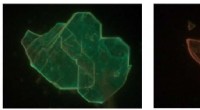
In the world of materials science, defects are often seen as a negative thing. They can disrupt the regular arrangement of atoms in a material, making it weaker or less efficient. However, a new study has shown that some defects can actually be beneficial.
Researchers at the University of California, Berkeley, have discovered a new type of defect in layered polymers called helicoidal screw dislocations. These defects are tiny twists in the polymer chains that form a spiral shape. The researchers found that these defects can actually improve the mechanical properties of the polymer, making it stronger and more flexible.
The discovery of helicoidal screw dislocations could lead to the development of new materials with improved properties. These materials could be used in a variety of applications, such as in the aerospace industry, where lightweight and strong materials are essential.
Helicoidal screw dislocations are a type of defect in layered polymers that are characterized by a spiral-shaped twist in the polymer chains. These defects can be created when the polymer is subjected to stress, such as when it is stretched or compressed.
The researchers found that helicoidal screw dislocations can actually improve the mechanical properties of polymers by increasing their strength and flexibility. This is because the defects act as a kind of "lubricant" for the polymer chains, allowing them to slide past each other more easily. This makes the polymer more resistant to deformation, making it stronger and more flexible.
The discovery of helicoidal screw dislocations could lead to the development of new materials with improved properties. These materials could be used in a variety of applications, such as in the aerospace industry, where lightweight and strong materials are essential. Other potential applications include in the automotive industry, the construction industry, and the medical device industry.
The discovery of helicoidal screw dislocations is a significant breakthrough in the field of materials science. These defects could lead to the development of new materials with improved properties that could be used in a variety of applications.