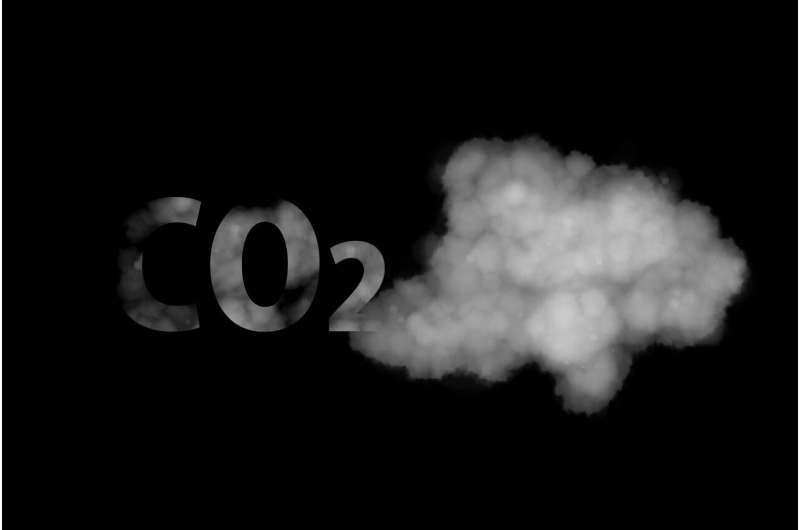
Electrochemical conversion of CO2 into value-added chemical fuels driven by renewable electrical energy has roles in reducing net CO2 emission and in addressing energy consumption.
Although considerable progress has been made in CO2 electroreduction, carbonate formation can cause serious CO2 loss. CO2 conversion in acidic electrolyte is an attractive way to overcome the problem of CO2 loss, however, selective reduction remains a challenge.
In a study published in Energy & Environmental Science, a research team from the Shanghai Advanced Research Institute (SARI) of the Chinese Academy of Sciences designed a Cu hollow fiber penetration electrode to electroreduce CO2 in strong acid with effective inhibition of hydrogen evolution reaction (HER).
By virtue of the unique penetration effect induced by Cu hollow fiber, abundant CO2 molecules were supplied to Cu active sites. The Cu surface possessed enough high CO2 coverage, which suppressed HER and facilitated CO2 reduction to C2+ products.
Thus, a CO2 single-pass conversion rate exceeding 51% with a C2+ Faradaic efficiency of 73.4% and partial current density of 2.2 A cm-2 were achieved in acidic solution (pH = 0.71). The performance of the Cu penetration electrode was approximated to or even exceeded those of the state-of-the-art Cu base catalysts.
This work represents progress in the design and development of new electrode configurations to realize CO2 electroreduction to high-value C2+ chemicals with scalable applications.
More information: Chang Zhu et al, Selective CO2 electroreduction to multicarbon products exceeding 2 A cm−2 in strong acids via a hollow-fiber Cu penetration electrode, Energy & Environmental Science (2023). DOI: 10.1039/D3EE02867D
Journal information: Energy & Environmental Science
Provided by Chinese Academy of Sciences