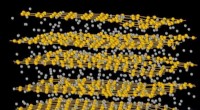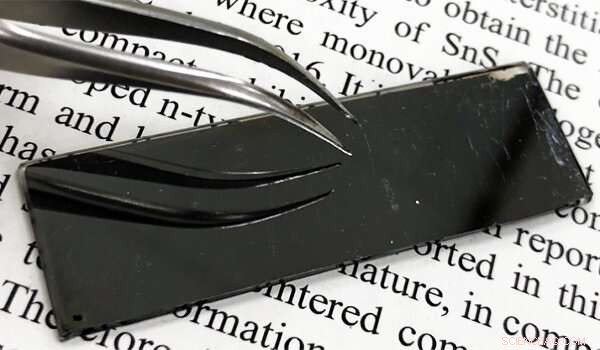
The world's first n-type conductive SnS thin film without containing toxic elements. Credit: Issei Suzuki et al.
Tin sulfide (SnS) is an abundant, safe, and environmentally friendly solar cell material. This inexpensive material is forecast to be used in next-generation solar cell panels.
A research group led by Issei Suzuki and Sakiko Kawanishi, assistant professors at Tohoku University's Institute of Multidisciplinary Research for Advanced Materials, has fabricated n-type conductive SnS thin films by impurity doping for the first time.
Conventional SnS thin films are usually p-type conductive. Thus, SnS thin-film solar cells have been fabricated using a pn heterojunction with p-type SnS thin film and other n-type semiconductor thin films, such as CdS. However, the conversion efficiency of such heterojunction devices has stagnated at approximately 5%, rendering their use impractical.
The SnS thin-film solar cells employing a pn homojunction, which uses SnS thin films for both p-type and n-type layers, is expected to exhibit higher conversion efficiency. Yet, n-type conducive SnS thin films without toxic elements have never been achieved before.
Using chlorine-doping and a sulfur plasma supply, the research group reduced the lattice defects inhibiting the n-type conversion of SnS, realizing the world's first n-type SnS thin films without toxic elements.
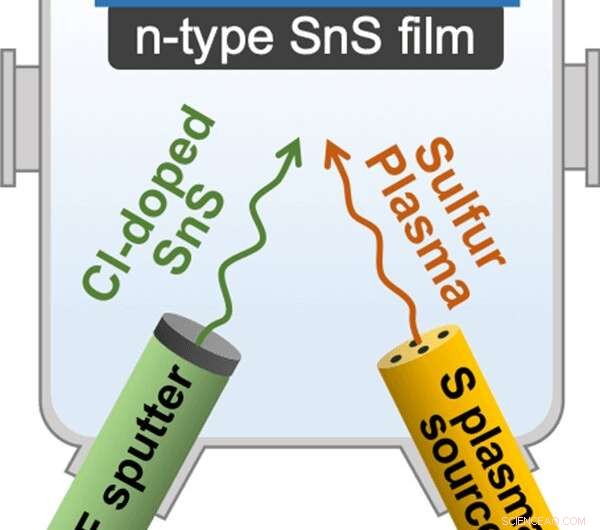
A schematic illustration of the new technique used to fabricate n-type SnS thin films. The n-type conductive SnS thin films were achieved by fabricating thin films of chlorine(Cl)-doped SnS with a supply of sulfur plasma. Credit: Issei Suzuki et al.
"Our realization paves the way for practical pn homojunction SnS thin-film solar cells," said Suzuki.
The results of the research were published in Physical Review Materials on December 9, 2021.