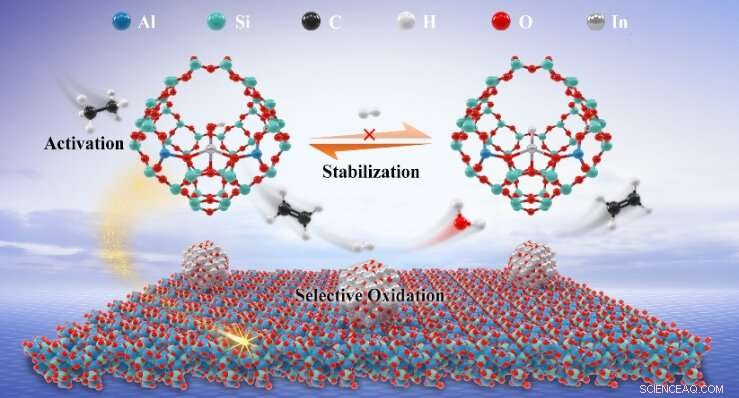
Schematic of the local coordination environment of isolated In site and proposed selective oxidative dehydrogenation process on main-group In catalyst. Credit: WANG Chaojie
Transition metal oxides are catalysts for the oxidative dehydrogenation of alkanes. However, they suffer from an inferior alkene yield due to the trade-off between conversion and selectivity induced by more reactive alkenes than alkanes.
Recently, a research group led by Prof. Wang Xiaodong and Prof. Zhang Tao from the Dalian Institute of Chemical Physics (DICP) of the Chinese Academy of Sciences (CAS) proposed and demonstrated a new concept to achieve high alkene yields by regulating the activation of intrinsically selective catalysts for alkanes from weakness to strength.
This study was published in Journal of the American Chemical Society on Aug. 25.
The researchers designed a main-group catalyst with atomically dispersed In sites to disentangle the dilemma of trade-off between activity and selectivity in oxidative dehydrogenation process.
This novel catalyst exhibited exceeding 80% C2H4 selectivity at around 80% C2H4 conversion, thus achieving more than 60% C2H4 yield, which outperformed the state-of-the-art transition metal oxide catalysts.
Moreover, the researchers found that atomically dispersed [InOH]2+ sites anchored by substituting the protons of supercages in HY enabled the activation of ethane via significantly lowering the barrier of ethane dissociation and their structure could be stabilized by H2O formed from selective oxidation of hydrogen by In2O3 nanoparticles, thus exhibiting excellent performance for oxidative dehydrogenation of ethane.
"Our study unlocks new opportunities for the utilization of main-group elements and paves the way toward more rational design of catalysts for highly efficient selective oxidation catalysis," said Prof. Wang. + Explore further