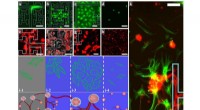
Cytokinesis is the process in which two cells that result from mitosis, or cell division, pinch apart into separate cells. Cytokinesis is made possible by microfilaments, which are filaments made of a protein called actin. Actin exists as a single protein, but can connect like LEGOs into a long rod. During cytokinesis, actin filaments are pulled into a bundle, like a belt, at the equator or waist between the two separating cells. Myosin motor proteins pull on the actin ring, causing the ring to shrink as the filaments simultaneously disassemble. The shrinking ring pulls the cell membrane with it, resulting in a pinching effect that separates the two cells.
During cytokinesis, a contractile ring of actin filaments forms at the equator between the two poles that will separate into two cells. The contractile ring is formed by the bundling of pre-existing microfilaments, or actin fibers, into the middle region. This contractile ring structure defines the region of pinching that occurs as the two poles of a dividing cell continue to push apart. Part of the reason the ring contracts is because the actin filaments that are in it depolymerize, meaning the filaments break apart into individual actin pieces. Blocking the process of depolymerization prevents the ring from contracting.
The purpose of the contractile ring is more than just a sturdy belt; it is also a railway on which myosin motor proteins “walk,” meaning they grab and pull parallel actin filaments in opposite directions. This pulling by myosins is part of what makes the ring contract, or shrink. Myosin proteins have a fist, or hand-like region that can grab onto an actin filament and pull, as well as light chains that regulate the activity of the hand. The light chains sit at the wrist region of the myosin, like bracelets, controlling the motion of the wrist and hand. The pulling activity myosin is another reason why the contractile ring shrinks. Deleting myosin or the myosin light chains slows down the rate of contraction. It also slows down the rate of actin depolymerization, which is required for contraction.
The purpose of the contractile ring is not just to shrink, but to pull the plasma membrane with it as it shrinks. The pulling of the membrane is what results in the “pinching” effect, as if the membrane between the two separating cells were being squeezed together on all sides. This pinching occurs because the contractile ring is connected to the plasma, or outermost, membrane of the cell at places throughout the circumference of the ring. These connections to the membrane, called nodes, also contain myosin motor proteins. What exactly happens at these nodes is unclear, but they play a part in pulling the membrane in, as the contractile ring shrinks.
In discussing the role of microfilaments in cytokinesis, it is easy to miss one of the most important features of actin filaments -- that is, their ability to depolymerize into individual molecules. Actin filaments are very dynamic in that they can form filaments very quickly, and break into individual units very quickly. When the contractile ring is done shrinking and pulling the membrane in, the remaining structure is called the midbody, which is the last connection between the two daughter cells of a cell division. This midbody contains a dense mixture of proteins and filaments called microtubules, but no actin filaments.