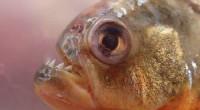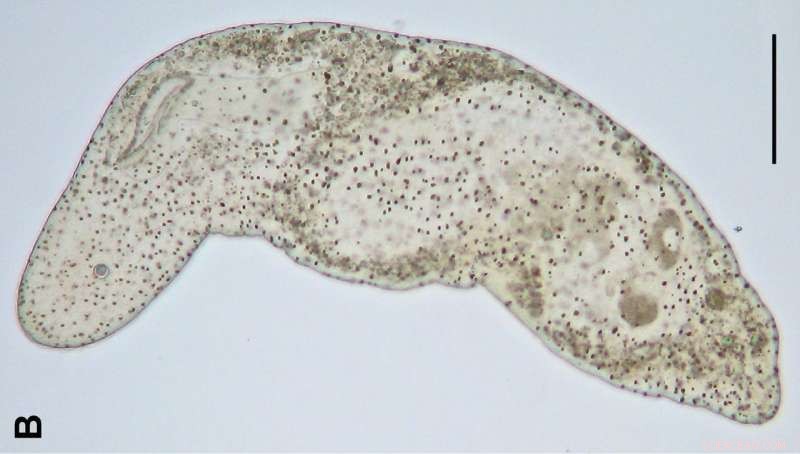
Proporus sp., a xenacoelomorph. Credit: Wikipedia/CC BY 2.5
(Phys.org)—A team of researchers from Norway, Sweden and Denmark has found evidence that suggests the nervous system evolved independently in multiple creatures over time—not just once, as has been previously thought. In their paper published in the journal Nature, the group describes their study of tiny sea creatures they collected from fjords in Norway and Sweden, from various sea floor locations, and from a site off the coast of Washington state, and what they found. Caroline Albertin and Clifton Ragsdale, with the University of Chicago, offer a News & Views piece on the work done by the team in the same journal issue.
Because the central nervous system similar looks so similar across species, it has been assumed for some time that it likely evolved just once in a very early common ancestor. But recent studies have shown that may not be the case. In this new effort, the researchers sought to gather more evidence of multiple instances of nervous system development by studying invertebrates scattered across the evolutionary tree with different types of central nervous system architectures. To that end, they collected tiny specimens from multiple locations and studied their lineage. They report that some of them belong to an ancient lineage called Xenacoelomorpha, which had a wide variety of nervous system types. Some had no central cord, they note, while others, such as modern jellyfish, have multiple cords—and one species has a cord running along its back reminiscent of vertebrates.
The team also looked at a gene called bmp, believed to be the gene that is responsible for kicking off the development of the nervous system. But another team had shown that in the acorn worm, it became active before the formation of the nervous system, suggesting other genes were also at play. After looking at the invertebrates they had collected, the team found other instances of the bmp gene becoming activated before the formation of nerve cords. They also found that blocking the protein that is produced when bmp becomes active did not prevent formation of the cord in some species. The group also found that other genes that have been associated with development of the nervous cord became active in some species that had no nervous cord at all.
The researchers claim their findings show that the nervous system evolved in different creatures at different times, which means that it evolved more than once.
© 2017 Phys.org