Credit: CC0 Public Domain
(Phys.org)—A team of researchers with members from the U.S., Portugal and France has conducted a study of the amount of energy required by the two main types of tortoises that reside on the Galapagos Islands—the domed and the saddleback—to flip themselves right side up when they overturn. In their paper published in Scientific Reports, the group describes analyzing shells of the two tortoise types, comparing them and then calculating which required more energy to flip itself back upright.
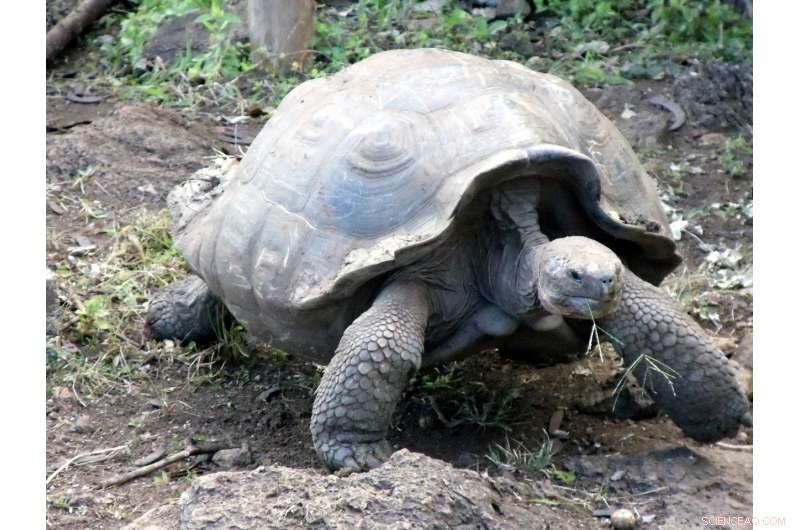
The giant tortoises that live on the Galapagos Islands are world famous due to their huge size. Less well known is that there are two main types defined by differently shaped shells: domed and saddleback. The domed species are the ones mostly seen in tourist pictures. Less popular are the saddleback, which have a shoehorn-shaped part of their shell near the neck, flatter shells and longer necks. Both kinds tend to tip over due to rough terrain or when fighting with one another. But which has to expend more energy to right itself? That is what the team on this new effort sought to find out.
To figure out how much energy each type would have to expend in tipping itself back upright, the researchers studied the techniques used by both: The domed species tend to move their legs around until they work up enough momentum to turn over. The saddlebacks, on the other hand, used their necks in addition to flailing their legs. The group then took pictures of 89 of the shells (many from inside museums) to create 3-D versions on a computer. Then, at the Rotterdam Zoo, the team hoisted one of the turtles onto a platform connected to equipment that produced the desired result.
Putting all their data together, the researchers found that saddleback tortoises have to use more energy to right themselves than do those of the domed species. Noting that being unable to flip over is a leading cause of death of the tortoises, the group suggests the different shell types may have evolved to handle tipping under different environmental circumstances.
© 2017 Phys.org