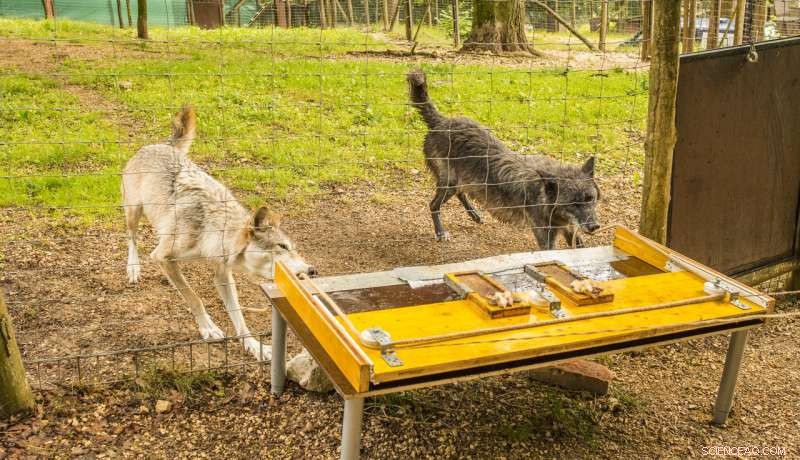
wolves working at a cooperative rope-pulling test. Credit: Rooobert Bayer (Wolf Science Center, Ernstbrunn, Austria).
(Phys.org)—A team of researchers from the Wolf Science Center and the Comparative Cognition, Messerli Research Institute, both part of the Medical University of Vienna, has found that packs of wolves behave more cooperatively among themselves than do groups of dogs. In their paper published in Proceedings of the National Academy of Sciences, the group describes how they tested both groups of animals at their research institute and what they found by doing so.
As the researchers note, the consensus among scientists is that dogs are more social than wolves because they have been bred over multiple generations to be social with humans. But do those social skills apply to cooperation with other dogs? That was the question that motivated the researchers to set up an experiment to compare the two groups in a contrived social setting.
To test the degree of cooperation of members of a wolf pack or group of dogs, the researchers set up an apparatus that allowed two animals to work together to gain access to a food reward. To obtain a bowl of food, both animals had to tug on separate ropes at the same time—in short, they had to cooperate for the benefit of both.
The researchers ran the experiment hundreds of times with multiple pairs of dogs and wolves and then tallied the results. They found that dogs were not good at cooperating to gain a meal—out of 472 tries, the dogs succeeded in getting their reward just two times. The wolves, on the other hand, were much better, getting their reward 100 times out of 416 tries.
The researchers noted that the wolves did best when paired with familiar partners that also held the same "rank" in the pack. In watching how the animals went about their task, the researchers found that the wolves were much more willing to approach the food bowl together, rather than one waiting for the other. With dogs, the researchers note, the one that is dominant usually goes first, otherwise fighting erupts. The researchers suggest that by approaching the bowl together, the wolves were able to see more clearly what needed to be done to get their food reward.
The researchers suggest that while dogs have clearly learned to be more social and cooperative with humans over the years, they appear to be less so with other dogs.
© 2017 Phys.org