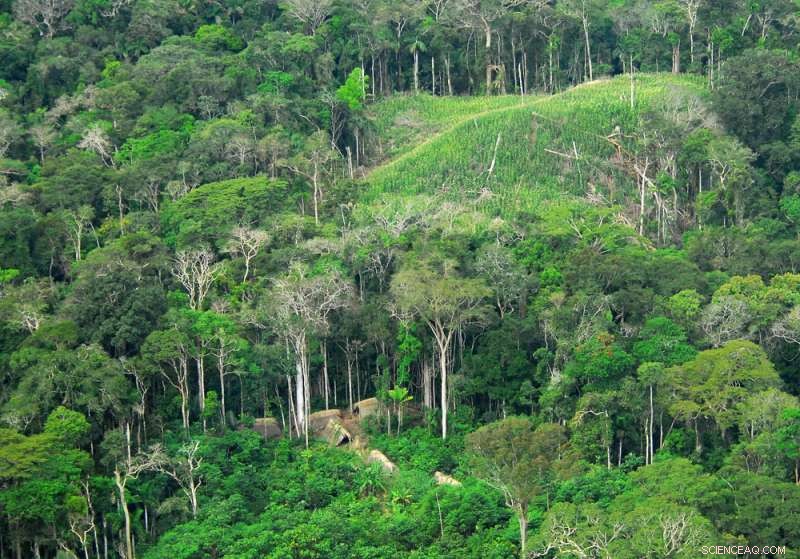
Uncontacted indigenous tribe in the brazilian state of Acre. Credit: Gleilson Miranda / Governo do Acre / Wikipedia
(Phys.org)—A large team of researchers from Brazil, the U.K., Columbia and Spain has found that scientists have identified 14,003 types of plants growing in a major part of the Amazon rain forest. In their paper published in Proceedings of the National Academy of Sciences, the group describes the many ways they searched for listings of plant types in the area and how they came up with a total.
Anyone who has ever visited the Amazon rain forest knows that there are many types of plants there—perhaps too many to count. No one has ever been able to say for sure how many types there are because of the difficulty in finding and identifying them. But that has not stopped some scientists from making estimates. Some have suggested the number of types is likely in the tens of thousands; others have gone further, suggesting the number may be in the hundreds of thousands. In this new effort, the researchers did not go to the Amazon jungle. Instead, they sought to count how many plant types other people have found and reported.
To arrive at this number, the researchers pored through research papers, databases and any other reliable source they could find—keeping a tally as they went. Then they did some cross-checking and verification and eliminated those that could not be verified. The task actually involved many more people than are listed in the paper, numbering in the hundreds.
The result was not only a count, but a list of every known plant that grows in the lowland portion (lower than 1000 meters) of the Amazon biome. The team reports the number of plant types to be 14,003, 6,727 of which are trees. The rest are vines, herbs, lianas, shrubs and small trees. The researchers are not suggesting that this is the total number of plants in the area—clearly, there are many plants that have not been found and identified. But it does suggest that the total number is likely closer to tens of thousands, rather than hundreds of thousands. The finished list represents a valuable tool for those who study plant life in the Amazon—it should help prevent duplicate research and provide a base for adding new finds in the future.
© 2017 Phys.org