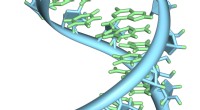
You’ve got your mother’s hair, your father’s eyes and your grandfather’s nose. You are a patchwork because of heredity. Half of your genes come from your mother and half from your father. Everyone has about 25,000 genes that determine traits such as height and skin tone. Some traits are caused by a combination of genes, so it’s not easy to predict what offspring will be like. Traits have two or more possible genetic variations called “alleles.”
A genetic trait has two or more alternatives or alleles. For example, natural hair color might be brown, black, blonde or red. For each trait, you get alleles from each parent. How these are expressed largely depends upon which one dominates the other. Some variations show up over others. For instance, the allele for brown eyes is dominant. If you get a brown-eyed allele from your dad and a blue-eyed one from your mom, you will have brown eyes. The allele for blue eyes is recessive; that means it won’t show up unless you get blue-eyed alleles from both parents.
Some diseases are inherited, and, in many, the alleles are recessive. You need to inherit the disease allele from each parent to get the disease. For instance, cystic fibrosis is recessive. People with CF produce a lot of mucus, leading to severe lung problems. Phenylketonuria is also recessive. People with this disease cannot process the amino acid phenylalanine, which leads to brain damage. Hemophilia A, a condition where blood does not clot normally, is caused by a recessive allele, but it is only found on an X chromosome. A female has two X chromosomes, so, in order for her to have the disease, both chromosomes must contain the hemophilia allele. However, a male has one X chromosome and one Y chromosome. If the allele for hemophilia appears on his X chromosome, he will have hemophilia A.
Many facial features show up when people inherit recessive alleles. For example, although ear lobes often hang free, some are attached directly to the head. The attached allele is recessive. The allele for dimples is dominant, so if you have none, you have inherited non-dimple alleles. Check your eyebrows. The allele for slender brows is recessive. When you see someone with a cleft in the chin, you know that person has inherited recessive alleles. It’s the same for short eyelashes, no freckles, joined eyebrows or a straight hairline. All of these alleles are recessive.
Recessive alleles are obvious in other parts of the body, too. Stretch out the fingers of one hand. If your thumb curves, you have recessive alleles. Interlace your fingers in front of you. Which thumb is on top? If you naturally put your right thumb over your left, you have recessive alleles. Recessive alleles are also responsible if you have no hair on the back of your hand, if your little finger is straight rather than bent and if your big toe is longer than the one right next to it.