The term "morphology" describes the shape, form or growth habit of an organism and its parts. Algae exhibit extremely diverse morphology. Some, like Chlorella, are unicellular organisms similar to bacteria, whereas others such as kelp are complex, multicellular organisms with cells similar to plants. Other algae run the gamut of morphological diversity, but can be categorized into several major groups.
Unicellular algae consist of a single cell. The single cell of the body contains a chloroplast, which conducts photosynthesis to create energy from sunlight, and often contains a structure called a pyrenoid that can store energy and contractile vacuoles that help to regulate the amount of water and salts within the cell (i.e., osmoregulation). Some unicellular algae such as Chlamydomonas are motile, or able to move, using flagella.
Colonial algae include different numbers of cells. Some, such as Gonium, consist of a small group of cells, whereas others, such as Volvox, consist of hundreds of cells. Specialized colonies called coenobium contain a specific number of cells, each with their own tasks, that cannot survive alone. Like unicellular algae, many colonial algae are motile.
Filamentous algae undergo cell division but remain connected, forming long filaments of attached cells. Each cell within the filamentous alga has its own internal structures, such as a chloroplast, and is capable of photosynthesis. Spirogyra is one commonly-studied alga. At low tide, this stringy, green algae is exposed on rocks. Under the microscope, Spirogyra reveals a unique, spiral arrangement of chloroplasts.
Siphonous algae have a morphology that superficially resembles that of filamentous algae. However, siphonous algae consist of only one single cell with branching sections. Enteromorpha is a siphonous algae that appears similar to Spirogyra to the naked eye.
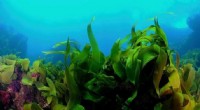
Certain red algae contain boxy, plant-like cells and have a complex, multicellular structure that is termed "parenchymatous." Although the cells of algae do not truly differentiate to form various structures, these parenchymatous algae often have parts that resemble leaves, stems and roots. Kelp grows to immense lengths, and is perhaps one of the best-known parenchymatous algae.