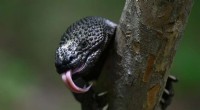
Gabon’s Abanda Cave system houses an extraordinary, underground population of Osteolaemus tetraspis—the African dwarf crocodile that has evolved a striking orange hue, a color never before documented in this species.
While the typical dwarf crocodile roams the rainforests, swamps, and rivers of West Africa, growing to about 5 ft (1.5 m) in length, the cave‑dwelling cohort has lived in perpetual darkness for roughly 3,000 years.
In 2008, archaeologist Richard Oslisly discovered the hidden room, initially searching for ancient rock art. Two years later, with Olivier Testa and herpetologist Matthew Shirley, they captured a specimen that would change our understanding of the species.
When the captured crocodile emerged, researchers noted its body was the familiar blue‑grey of the dwarf species, but its skin had turned a vivid orange. This pigmentation results from the reptile’s prolonged exposure to the cave’s alkaline water, heavily infused with bat guano. Bat guano—rich in urea—creates a high‑pH environment that tints the croc’s epidermis over time.
Abanda hosts over 100,000 Egyptian fruit bats (Rousettus aegyptiacus), Noack’s roundleaf bats (Hipposideros aff. ruber), and Giant leaf‑nosed bats (Hipposideros aff. Gigas). The crocodiles subsist primarily on these bats, cave crickets, and other cave fauna.
Genetic sequencing of multiple specimens revealed a unique haplotype absent in above‑ground dwarf crocodiles, confirming that the cave population diverged thousands of years ago. The orange coloration, however, is not genetically encoded but a result of the guano‑rich habitat.
The existence of a self‑sustaining, light‑free crocodile species underscores the species’ resilience and adaptive capacity. Studying this population may unlock new insights into ectothermic thermoregulation, genetic drift in isolated populations, and the ecological impact of bat colonies on subterranean ecosystems.
Sources: The Guardian, National Geographic.