Basic Components:
* Nucleotides: DNA is composed of repeating units called nucleotides. Each nucleotide consists of:
* Deoxyribose sugar: A five-carbon sugar molecule.
* Phosphate group: A negatively charged molecule containing phosphorus.
* Nitrogenous base: A molecule containing nitrogen that comes in four types:
* Adenine (A)
* Guanine (G)
* Cytosine (C)
* Thymine (T)
Double Helix:
* Two strands: DNA exists as two long strands of nucleotides that are twisted together to form a double helix, resembling a spiral staircase.
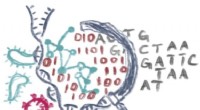
* Base pairing: The two strands are held together by hydrogen bonds between the nitrogenous bases. Adenine always pairs with thymine (A-T), and guanine always pairs with cytosine (G-C). This is called complementary base pairing.
* Antiparallel orientation: The two strands run in opposite directions. One strand runs from 5' to 3', while the other runs from 3' to 5'. This directionality is determined by the location of the phosphate group on the sugar molecule.
Further Structure:
* Sugar-phosphate backbone: The phosphate groups and deoxyribose sugars form the backbone of the DNA molecule, giving it its structural integrity.
* Grooves: The double helix has two grooves, a major groove and a minor groove, which provide access for proteins to interact with the DNA sequence.
Key Features:
* Complementary base pairing: This ensures that each strand carries the same genetic information, making DNA self-replicating.
* Antiparallel orientation: This allows for efficient replication and transcription.
* Double helix: Provides stability and protection for the genetic information encoded in the DNA sequence.
Significance:
The unique structure of DNA allows it to:
* Store genetic information: The sequence of nucleotides in DNA determines the order of amino acids in proteins, which control cellular function.
* Replicate itself: DNA can make exact copies of itself during cell division, ensuring the transmission of genetic information to daughter cells.
* Express genetic information: DNA provides the instructions for the synthesis of proteins, which carry out the functions of the cell.
Understanding the structure of DNA is fundamental to understanding how genes work and how they can be manipulated in various fields like medicine, agriculture, and biotechnology.