Here's why:
* No nucleus: Prokaryotes lack a nucleus and other membrane-bound organelles that eukaryotic cells have. This means they don't go through the complex processes of mitosis or meiosis.
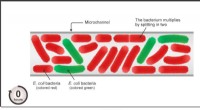
* Direct duplication: In binary fission, the single circular chromosome replicates, and the cell elongates. Then, the cell wall pinches inwards, eventually dividing the cell into two identical daughter cells.
So, while binary fission is not classified as mitosis or meiosis, it's a fundamental process for prokaryotic reproduction and is often described as a form of direct cell division.