Here's why:
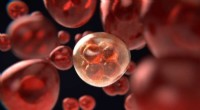
* Unicellular organisms are single-celled. This means their entire body is composed of a single cell.
* Reproduction is by division. They reproduce asexually, typically through processes like binary fission (splitting into two identical cells) or budding (producing a smaller copy of the parent cell).
So, a single cell divides to create two identical cells, each of which is a complete, independent organism.