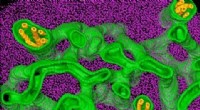
* Individual Cells: Each cell in a chain or cluster is a complete, independent organism. It has its own cell wall, membrane, nucleus, and all the necessary machinery for life. They aren't fused together like a multicellular organism.
* Budding Reproduction: Yeast reproduce asexually by budding. A small outgrowth (bud) forms on the parent cell, grows, and eventually breaks off to become a new, independent yeast cell. This process doesn't create a continuous organism, but rather separate individuals.
* Chains vs. Multicellularity: The chains formed by yeast cells are not a true multicellular structure like tissues or organs in animals. The cells in a chain don't specialize or cooperate in a coordinated way. They are simply attached to each other, often temporarily, during the budding process.
Think of it this way: Imagine a group of people holding hands. Each person is an individual, but they are temporarily connected. This is similar to how yeast cells are linked together. They can function independently, but they might be physically linked for a short period.
So, while yeast cells may form chains or clusters, they are still single-celled organisms because each cell is a self-sufficient, independent life form.