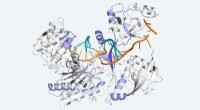
Here's a breakdown:
* Double: DNA consists of two strands of nucleotides running in opposite directions (antiparallel). These strands are connected by hydrogen bonds between the nitrogenous bases.
* Helix: The two strands twist around each other, forming a spiral shape. This shape is similar to a twisted ladder, where the rungs of the ladder are the base pairs and the sides of the ladder are the sugar-phosphate backbones.
Key features of the DNA double helix:
* Antiparallel: The two strands run in opposite directions, with one strand running from 5' to 3' and the other from 3' to 5'.
* Base pairing: Adenine (A) pairs with thymine (T), and guanine (G) pairs with cytosine (C).
* Sugar-phosphate backbone: The sides of the helix are formed by alternating sugar and phosphate groups.
* Major and minor grooves: The helix has two grooves, a major groove and a minor groove, which provide binding sites for proteins.
The double helix structure of DNA is crucial for its function as the genetic material. It allows for:
* Stable storage of genetic information: The double helix provides a stable structure for the DNA molecule.
* Accurate replication: The base pairing rules allow for the accurate replication of DNA during cell division.
* Regulation of gene expression: The structure of DNA provides binding sites for proteins that control gene expression.