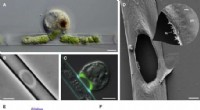
* Presence of a Nucleus: Fungi cells have a true nucleus, which contains their genetic material (DNA) enclosed within a membrane. This is a defining characteristic of eukaryotic cells.
* Organelles: Fungi cells possess other membrane-bound organelles like mitochondria, endoplasmic reticulum, Golgi apparatus, and ribosomes. These organelles perform specialized functions within the cell, which is another hallmark of eukaryotic cells.
* Cell Wall: While fungi have cell walls, the composition of these walls is different from that of prokaryotic cells. Fungi cell walls are primarily composed of chitin, a complex carbohydrate.
Prokaryotic cells, on the other hand, lack a nucleus and other membrane-bound organelles. They have a simpler structure and their DNA is located in a region called the nucleoid.
Therefore, the presence of a nucleus and other membrane-bound organelles clearly places fungi in the domain of eukaryotes.