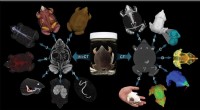
Homologous structures are structures that are similar in different species because they share a common ancestor. These structures may have different functions, but they have the same underlying anatomical organization.
Here's a breakdown:
* Homology refers to the relationship between these structures.
* Homologous structures are the actual physical structures themselves.
For example, the forelimbs of a human, a bat, a whale, and a bird are all homologous structures. While they have different functions (grasping, flying, swimming, and perching, respectively), they all share a common skeletal structure that can be traced back to a common ancestor.
Homology provides strong evidence for evolution. It suggests that these diverse organisms share a common ancestor and have evolved over time to adapt to different environments.