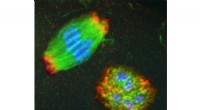
Here's a breakdown:
* Formation: The cleavage furrow forms as actin filaments (a type of protein) and myosin (a motor protein) assemble at the cell's equator. These proteins contract, pulling the plasma membrane inward.
* Progression: The furrow deepens and narrows, progressively constricting the cell like a drawstring bag.
* Completion: Eventually, the furrow completely pinches off the cell, creating two separate daughter cells.
Importance:
* Cell division: The cleavage furrow is crucial for ensuring that the cytoplasm is evenly divided between the daughter cells, maintaining the proper cellular content.
* Organism development: It plays a fundamental role in the development of multicellular organisms, allowing for the growth and formation of tissues and organs.
Note: Cleavage furrows are typically observed in animal cells. Plant cells use a different mechanism called cell plate formation to divide their cytoplasm.