Here's a breakdown:
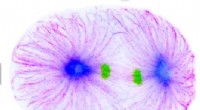
* Spindle fibers: These are made of microtubules, which are long, thin protein filaments.
* Centrioles: In animal cells, these small, cylindrical structures are involved in the formation of the spindle fibers. They duplicate and move to opposite poles of the cell.
* Kinetochore: A specialized protein structure that assembles at the centromere of each chromosome. Spindle fibers attach to the kinetochore, allowing the chromosomes to be pulled apart during cell division.
During cell division (mitosis or meiosis):
1. The spindle fibers extend from the poles of the cell, forming a structure that looks like a starburst.
2. The spindle fibers attach to the kinetochores on the chromosomes.
3. The spindle fibers shorten, pulling the chromosomes towards opposite poles of the cell.
4. This movement ensures that each daughter cell receives a complete set of chromosomes.