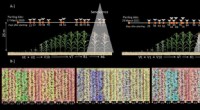
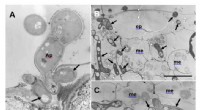
Here's a breakdown:
* Organ of Corti: This is the sensory receptor organ of the inner ear, located within the cochlea. It is responsible for converting sound vibrations into electrical signals that the brain can interpret.
* Tectorial Membrane: A gelatinous structure that sits atop the organ of Corti. It is composed of a fibrous meshwork and plays a crucial role in hearing.
How they work together:
1. Sound waves travel through the ear canal, causing the eardrum and ossicles (tiny bones) to vibrate.
2. These vibrations are transmitted to the fluid within the cochlea, causing waves to travel through it.
3. The movement of the fluid causes the basilar membrane (the base of the organ of Corti) to vibrate.
4. This vibration bends the hair cells (sensory cells) of the organ of Corti.
5. The bending of the hair cells is detected by the tectorial membrane, which is in direct contact with the hair cell stereocilia.
6. This interaction triggers a cascade of events, leading to the generation of electrical signals that travel to the brain via the auditory nerve.
Therefore, the tectorial membrane plays a crucial role in hearing by directly interacting with the hair cells within the organ of Corti.