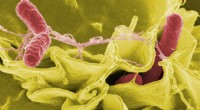
* Bacteria: These are single-celled organisms that are found in a wide variety of environments, from soil and water to the human body. They play a vital role in many ecological processes, such as nitrogen fixation and decomposition.
* Archaea: These are single-celled organisms that are often found in extreme environments, such as hot springs, salt lakes, and the digestive tracts of animals. They are distinct from bacteria in their biochemistry and genetics.
Examples of prokaryotic organisms:
* Bacteria: E. coli, Streptococcus, Lactobacillus, Salmonella, etc.
* Archaea: Halophiles, Thermophiles, Methanogens, etc.
It's important to note that all prokaryotic organisms are single-celled (unicellular), unlike eukaryotes which can be either single-celled or multicellular.