Here's why:
* Plants: Their cell walls are primarily composed of cellulose, providing structural support and rigidity.
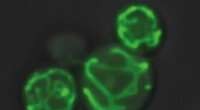
* Fungi: Fungal cell walls are made up of chitin, a strong and flexible material that helps maintain their shape.
* Bacteria: Bacterial cell walls are usually composed of peptidoglycan, a complex molecule that gives them structural integrity and protection.
* Some Protists: Certain protists, like algae, also possess cell walls, often made of cellulose or other polysaccharides.
The cell wall is a crucial component of these organisms, providing protection, shape, and allowing them to withstand internal pressure.