1. Simple Diagrams:
* Lock-and-key model: A simple diagram depicting the enzyme as a lock and the substrate (molecule it interacts with) as a key. This is a basic representation, but it effectively conveys the concept of specific binding.
* Induced-fit model: A slightly more detailed diagram showing the enzyme changing shape slightly to better accommodate the substrate. This emphasizes the flexibility of enzymes and how they can adapt to different substrates.
* Stick figures: Using simple lines to represent the molecules, with the enzyme and substrate shown in close proximity, potentially with some arrows illustrating the interaction.
2. Molecular Models:
* Ball-and-stick models: These use spheres to represent atoms and sticks to represent bonds. While basic, they allow for a more detailed representation of the molecules' structure.
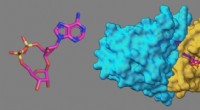
* Space-filling models: These models show the actual volume occupied by the atoms, offering a better visual of how the molecules fit together.
* Computer models: These can be highly detailed, showing the electron clouds and electrostatic interactions between the enzyme and substrate. These are particularly useful for visualizing complex interactions.
3. Animations:
* Animated diagrams: This can show the enzyme and substrate coming together, forming the enzyme-substrate complex, and then separating as the product is released. This adds a dynamic element to the illustration.
* Molecular dynamics simulations: These computationally-generated animations show the movement of atoms and molecules over time, providing a realistic depiction of how the enzyme interacts with its substrate.
4. Other Methods:
* Photographs: Images from electron microscopy or crystallography can show the actual structure of enzymes and how they bind to substrates.
* Analogies: Using analogies can help to explain the concept in an accessible way. For example, you could compare the enzyme to a glove, and the substrate to a hand.
Choosing the Best Method:
* Audience: Consider the age and background knowledge of your audience. Simple diagrams are best for younger audiences, while more detailed models and animations are suitable for advanced learners.
* Purpose: What are you trying to communicate? If you want to simply illustrate the basic concept of enzyme-substrate interaction, a simple diagram may suffice. If you need to show the specific interactions between atoms, a more complex model or animation is necessary.
* Resources: Some methods require specialized software or equipment.
Remember, the most important thing is to use an illustration that is clear, accurate, and engaging for your audience.