Here's a breakdown of the key distinctions between prokaryotic and eukaryotic cells:
1. Nucleus:
* Prokaryotes: Lack a true nucleus. Their DNA is located in a region called the nucleoid, which is not enclosed by a membrane.
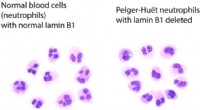
* Eukaryotes: Possess a well-defined nucleus enclosed by a nuclear membrane, which houses their DNA.
2. Organelles:
* Prokaryotes: Lack membrane-bound organelles like mitochondria, Golgi apparatus, endoplasmic reticulum, lysosomes, etc.
* Eukaryotes: Have a variety of membrane-bound organelles, each specialized for specific functions within the cell.
3. Size:
* Prokaryotes: Typically smaller in size (1-10 micrometers).
* Eukaryotes: Generally larger (10-100 micrometers).
4. Cell Wall:
* Prokaryotes: Most have a rigid cell wall made of peptidoglycan.
* Eukaryotes: Some eukaryotes (like plants and fungi) have cell walls, but they are composed of different materials (e.g., cellulose in plants, chitin in fungi).
5. DNA structure:
* Prokaryotes: Have a single, circular chromosome located in the nucleoid region.
* Eukaryotes: Have multiple linear chromosomes located within the nucleus.
6. Ribosomes:
* Prokaryotes: Have smaller ribosomes (70S).
* Eukaryotes: Have larger ribosomes (80S).
7. Reproduction:
* Prokaryotes: Reproduce asexually through binary fission.
* Eukaryotes: Reproduce both asexually (e.g., mitosis) and sexually (e.g., meiosis).
8. Complexity:
* Prokaryotes: Simpler in structure and organization.
* Eukaryotes: More complex in structure and organization with specialized compartments and functions.
9. Examples:
* Prokaryotes: Bacteria and Archaea.
* Eukaryotes: Plants, animals, fungi, protists.
In summary:
Prokaryotic cells are simpler, smaller, and lack a nucleus and membrane-bound organelles, while eukaryotic cells are larger, more complex, and have a well-defined nucleus and various organelles.
This table provides a more visual comparison:
| Feature | Prokaryotes | Eukaryotes |
|---|---|---|
| Nucleus | Absent | Present |
| Organelles | Absent | Present |
| Size | Smaller (1-10 µm) | Larger (10-100 µm) |
| Cell Wall | Present (peptidoglycan) | Present in some (cellulose, chitin) |
| DNA structure | Single circular chromosome | Multiple linear chromosomes |
| Ribosomes | 70S | 80S |
| Reproduction | Binary fission (asexual) | Mitosis (asexual), Meiosis (sexual) |
| Complexity | Simpler | More complex |
| Examples | Bacteria, Archaea | Plants, animals, fungi, protists |