Similarities:
* All cells share basic structures: All three types of cells possess a cell membrane, cytoplasm, ribosomes, and DNA.
* Basic functions: All cells perform essential life functions like metabolism, protein synthesis, and reproduction.
Differences:
| Feature | Plant Cell | Animal Cell | Bacterial Cell |
|---|---|---|---|
| Cell Wall | Present, made of cellulose | Absent | Present, made of peptidoglycan |
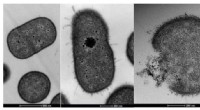
| Nucleus | Present, membrane-bound | Present, membrane-bound | Absent, DNA is in a nucleoid region |
| Organelles | Contains chloroplasts, vacuoles, and plastids | Contains lysosomes, Golgi apparatus, and centrioles | Lack most organelles, only ribosomes |
| Size | Generally larger | Generally smaller | Much smaller |
| Mode of Nutrition | Autotrophic (photosynthesis) | Heterotrophic (obtain food from other organisms) | Mostly heterotrophic, but some are autotrophic |
| Reproduction | Primarily asexual (mitosis) | Primarily sexual (meiosis) | Primarily asexual (binary fission) |
| Movement | Mostly immobile | Usually motile | Many are motile using flagella |
Detailed Explanation:
* Cell Wall: The rigid cell wall provides structure and support to plant cells. It is also present in bacteria, but composed of peptidoglycan. Animal cells lack a cell wall.
* Nucleus: Plant and animal cells have a nucleus that contains their DNA. Bacteria lack a membrane-bound nucleus and instead have their DNA located in a region called the nucleoid.
* Organelles: Plant cells contain chloroplasts for photosynthesis and large vacuoles for storage. Animal cells have lysosomes for digestion and a Golgi apparatus for processing and packaging proteins. Bacteria have very few organelles, with only ribosomes for protein synthesis.
* Size: Plant cells are generally larger than animal cells. Bacterial cells are the smallest of the three types.
* Mode of Nutrition: Plants are autotrophs, meaning they can make their own food through photosynthesis. Animals are heterotrophs and obtain food from other organisms. Bacteria can be either autotrophic or heterotrophic depending on the species.
* Reproduction: Plant cells reproduce primarily through mitosis. Animal cells reproduce primarily through meiosis, which allows for genetic diversity. Bacteria reproduce asexually through binary fission.
* Movement: Most plant cells are immobile. Animal cells can move through the use of cilia or flagella. Many bacteria are motile and use flagella for movement.
In Summary:
While all cells share basic similarities, plant, animal, and bacterial cells exhibit distinct features that reflect their unique functions and environments. These differences highlight the diversity of life and the adaptability of cells.