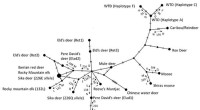
Here's why:
* Evolutionary Relationships: Proteins are coded by genes, and genes are passed down from parents to offspring. If two species share a very similar protein, it means their genes for that protein are also very similar. This strongly suggests that these species inherited the gene from a common ancestor.
* Molecular Homology: The similarities in protein structure and function are referred to as molecular homology. This is a powerful tool for understanding evolutionary relationships because it provides a tangible link between organisms at the molecular level.
* Mutations and Time: Over time, mutations accumulate in genes. If two species diverged from a common ancestor a long time ago, their versions of the protein will have accumulated more differences due to independent mutations. If they diverged recently, their proteins will be more similar.
Example: The protein hemoglobin, which carries oxygen in blood, is very similar in humans and chimpanzees. This is strong evidence that humans and chimpanzees share a recent common ancestor.