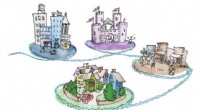
* Animals: From microscopic invertebrates to giant whales, all animals are made up of eukaryotic cells.
* Plants: Trees, flowers, ferns, and all other plant life are made up of eukaryotic cells.
* Fungi: Mushrooms, yeasts, and molds are all eukaryotic organisms.
* Protists: A diverse group of single-celled organisms like amoeba, paramecium, and algae are eukaryotic.
Organelles are specialized structures within a cell that carry out specific functions. Examples include:
* Nucleus: Contains the cell's genetic material (DNA).
* Mitochondria: Powerhouses of the cell, responsible for energy production.
* Chloroplasts: Found in plant cells, responsible for photosynthesis.
* Golgi apparatus: Modifies and packages proteins.
* Endoplasmic reticulum: Involved in protein synthesis and lipid metabolism.
Prokaryotes (bacteria and archaea) do not have organelles. Their genetic material is not enclosed in a nucleus, and other functions are carried out by specialized regions within the cytoplasm.