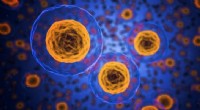
* They are the building blocks of all living organisms: Everything living, from single-celled bacteria to complex humans, is made up of one or more cells.
* They carry out all the essential functions of life: Cells are self-sufficient in the sense that they can take in nutrients, convert energy, eliminate waste, and reproduce on their own.
* They contain genetic material: Cells possess DNA, the blueprint for life, which guides all their activities and is passed down to new cells.
* They are self-regulating: Cells maintain internal conditions, like temperature and pH, within a narrow range, demonstrating a level of control necessary for life.
Essentially, cells represent the fundamental level at which the characteristics of life - growth, reproduction, metabolism, response to stimuli, and adaptation - are manifested. Without cells, there would be no life as we know it.
Here's a simple analogy: Think of a house. You can build a house with bricks, but you can't build a house with just sand. Bricks are the basic building blocks, and cells are the bricks of life.