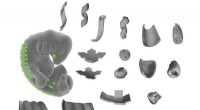
Here's how embryonic development supports the theory of evolution:
* Shared features in early development: Embryos of different species, even those that look very different as adults, often share striking similarities in their early stages of development. For example, all vertebrate embryos (fish, amphibians, reptiles, birds, mammals) have gill slits, a tail, and a notochord at some point during their development. These features are remnants of their shared evolutionary ancestry.
* Loss of ancestral features: As development progresses, these ancestral features can be modified or lost in some species. For example, in humans, the gill slits develop into parts of the ears, throat, and neck, while the tail regresses and becomes the coccyx. This loss of ancestral features reflects adaptation to different environments and lifestyles.
* Transitional forms: Embryonic development can also reveal transitional forms that link different species. For example, the embryos of some fish develop limbs before they develop fins, suggesting a link between fish and land-dwelling vertebrates.
* Comparative embryology: By comparing the embryonic development of different species, we can identify homologous structures, which are structures that have the same evolutionary origin but may have different functions. This allows us to trace the evolutionary relationships between different species.
However, it's important to note that the concept of recapitulation is not without its limitations. While some similarities in embryonic development can be explained by shared ancestry, others might be due to similar developmental mechanisms or environmental influences.
Overall, the study of embryology provides valuable insights into the evolutionary relationships between species and strengthens the evidence for the theory of evolution. It allows us to trace the history of life on Earth by observing the development of individual organisms and their shared ancestral traits.