1. Homology:
* Definition: Homologous structures are anatomical features shared by different species due to a common ancestor. These structures may have different functions in different species, but share a similar underlying structure.
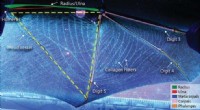
* Example: The forelimbs of a bat, a whale, a human, and a bird all have a similar bone structure (humerus, radius, ulna, etc.), even though they are used for flying, swimming, grasping, and walking, respectively. This shared structure points to a common ancestor that had this limb structure.
2. Vestigial Structures:
* Definition: Vestigial structures are reduced or non-functional body parts that were present and functional in an ancestral species.
* Example: Humans have a tailbone (coccyx) which is a remnant of a tail, a feature present in our primate ancestors. The appendix in humans is also believed to be a vestigial organ. These features indicate that humans evolved from ancestors that had these structures.
3. Adaptive Radiation:
* Definition: Adaptive radiation occurs when a single ancestral species rapidly diversifies into many new species, each adapted to different ecological niches.
* Example: The finches on the Galapagos Islands, famously studied by Darwin, are a prime example. These finches all evolved from a common ancestor, but adapted to different food sources on the various islands, resulting in variations in beak size and shape. This illustrates how natural selection can drive rapid diversification.
4. Comparative Embryology:
* Definition: The study of embryos of different species reveals similarities in early development, even in organisms that look very different as adults.
* Example: Fish, reptiles, birds, and mammals all have gill slits and tails at some point during embryonic development. These similarities suggest that these organisms share a common ancestry.
5. Molecular Evidence:
* Definition: Advances in molecular biology have provided overwhelming evidence for evolution. Comparisons of DNA and protein sequences among species show striking similarities that reveal evolutionary relationships.
* Example: The genetic code, the set of rules that translates DNA into proteins, is virtually identical across all living organisms. This suggests a common ancestor for all life.
In summary: The body structures of species, both homologous and vestigial, reveal evolutionary relationships and adaptations. Adaptive radiation demonstrates how species diversify over time, while comparative embryology and molecular evidence provide further support for shared ancestry. These insights help us understand the processes of evolution and the history of life on Earth.