Here's a breakdown:
* DNA itself is a long, thin molecule that contains the genetic instructions for an organism.
* Chromatin is the complex of DNA and proteins that make up chromosomes. The proteins help to package and organize the DNA, allowing it to fit within the nucleus of a cell.
* Chromosomes are the condensed, organized structures of DNA that are visible during cell division.
In a non-dividing cell:
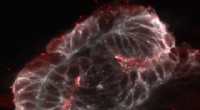
* DNA is loosely packaged in chromatin, forming a tangled mass within the nucleus.
* This loose structure allows access to genes for transcription and other cellular processes.
During cell division:
* Chromatin condenses into compact chromosomes, making them visible under a microscope.
* This condensation allows the chromosomes to be separated accurately into daughter cells.
So, while a cell is not dividing, DNA is not floating freely in the nucleus. It is organized into chromatin, which allows for efficient access to genetic information while still ensuring the proper packaging of this important molecule.