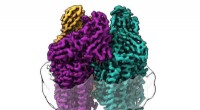
Here's how it works:
1. Binding: RNA polymerase binds to a specific region on the DNA called the promoter.
2. Unwinding: The enzyme unwinds the DNA double helix, separating the two strands.
3. Transcription: RNA polymerase uses one strand of the DNA as a template to synthesize a complementary RNA strand, known as messenger RNA (mRNA). This process is called transcription.
4. Elongation: RNA polymerase moves along the DNA strand, adding RNA nucleotides one by one to the growing mRNA chain.
5. Termination: When RNA polymerase reaches a specific termination signal on the DNA, it releases the newly synthesized mRNA molecule.
This mRNA molecule then carries the genetic code from the DNA to the ribosomes, where it is translated into a protein.