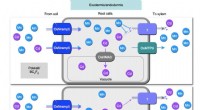
1. Processing and Packaging:
* Modifying proteins and lipids (fats): It adds sugars to proteins and lipids, making them functional or changing their destination.
* Sorting and packaging molecules: It packages molecules into vesicles (tiny sacs) for transport to other parts of the cell or out of the cell.
2. Synthesizing Certain Macromolecules:
* Polysaccharides: The Golgi apparatus can synthesize some polysaccharides, like those found in cell walls.
3. Transporting Molecules:
* Vesicles: It creates vesicles that carry molecules to various destinations within the cell.
* Secretion: Some vesicles fuse with the cell membrane, releasing their contents outside the cell (exocytosis).
In summary: The Golgi apparatus is crucial for many cell functions, including protein modification, lipid processing, packaging, and transportation of molecules within and outside the cell.
It's like a cellular factory that processes and packages raw materials into functional products, ready for delivery within the cell or to the outside world.