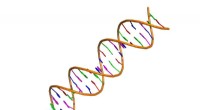
* DNA: The blueprint of life. It contains the genetic instructions for building and maintaining an organism.
* Genes: Specific segments of DNA that provide the code for a particular protein.
* Transcription: The process where a gene's DNA sequence is copied into a messenger RNA (mRNA) molecule.
* Translation: The process where the mRNA sequence is used to build a protein chain (polypeptide) from amino acids.
* Protein Folding: The polypeptide chain then folds into a specific three-dimensional structure, becoming a functional protein.
The proteome is the complete set of proteins produced by an organism. It's important to note that the proteome is not a fixed set and can change depending on factors like cell type, developmental stage, and environmental conditions.
Therefore, DNA carries the information to produce a proteome by:
* Providing the genetic instructions for protein synthesis.
* Encoding the amino acid sequence of each protein.
* Dictating the order of amino acids in the polypeptide chains.
* Ultimately influencing the protein's structure and function.







![Hybrid Light-Sheet Microscope for Multi-Scale Imaging | [Your Company/Institution Name]](https://www.scienceaq.com/article/uploadfiles/202210/2022102023423947_S.jpg)