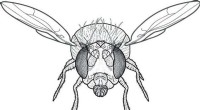
* The Expected Ratio: If the genes for body color and wing size were on separate chromosomes and assorting independently, you would expect a 9:3:3:1 phenotypic ratio in the F2 generation. This is the standard dihybrid cross ratio.
* The Observed Ratio: The 3:1 ratio you described indicates that only two phenotypes are appearing in significant numbers. This suggests the genes are linked.
Explanation of Linked Genes:
* Linked genes are located on the same chromosome.
* Crossing over (exchange of genetic material between chromosomes) can occur during meiosis, but it's less likely to happen between closely linked genes.
* The closer the genes are on the chromosome, the less likely they are to be separated by crossing over.
In this case:
* The gray body (G) and normal wing (W) alleles are likely on one chromosome.
* The black body (g) and vestigial wing (w) alleles are likely on the homologous chromosome.
* The parents were homozygous for these linked traits.
* The F1 generation would all be heterozygous for both traits (GgWw), but the alleles would tend to stay together due to linkage.
* In the F2 generation, only two main phenotypes appear because crossing over is less frequent, resulting in the 3:1 ratio.
Additional Points:
* Recombination Frequency: The 3:1 ratio suggests that the genes are fairly closely linked. If the genes were further apart, crossing over would be more likely, and you'd see more of the recombinant phenotypes.
* Test Cross: To confirm linkage, you could perform a test cross (F1 x homozygous recessive) and analyze the offspring ratios.
Let me know if you have any other questions!