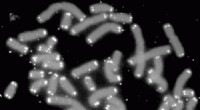
Mitosis: This is the process of nuclear division where one cell divides into two daughter cells, each with the same number of chromosomes as the parent cell.
Stages of Mitosis:
1. Prophase:
* Chromatin condenses into visible chromosomes.
* Nuclear envelope breaks down.
* Spindle fibers form from centrioles.
* Centrioles migrate to opposite poles of the cell.
2. Metaphase:
* Chromosomes line up at the metaphase plate (the middle of the cell).
* Each chromosome is attached to spindle fibers from both poles.
3. Anaphase:
* Sister chromatids of each chromosome separate and move to opposite poles of the cell.
* Spindle fibers shorten, pulling the chromatids apart.
4. Telophase:
* Chromosomes reach the poles and begin to uncoil.
* Nuclear envelope reforms around each set of chromosomes.
* Spindle fibers disappear.
* The cytoplasm begins to divide.
Cytokinesis: This is the division of the cytoplasm, which occurs after mitosis and results in two separate daughter cells.
Stages of Cytokinesis:
* Animal Cells:
* A cleavage furrow forms, pinching the cell membrane inward.
* The furrow deepens until it meets in the middle, dividing the cytoplasm and forming two daughter cells.
* Plant Cells:
* A cell plate forms in the middle of the cell, growing outward.
* The cell plate eventually fuses with the existing cell walls, dividing the cytoplasm and forming two daughter cells.
Key Differences:
* Mitosis involves nuclear division, while cytokinesis involves cytoplasmic division.
* Mitosis occurs before cytokinesis.
* Mitosis ensures that each daughter cell receives a complete set of chromosomes, while cytokinesis divides the cytoplasm and organelles.
Significance:
* Mitosis is essential for growth, development, and repair in multicellular organisms.
* It allows for the production of new cells to replace worn-out or damaged ones.
Note:
The specific timing and appearance of these stages may vary slightly depending on the organism and cell type.