1. Integral Membrane Proteins:
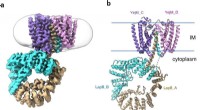
* These proteins are permanently attached to the membrane and are embedded within the lipid bilayer.
* They have hydrophobic regions that interact with the fatty acyl chains of the phospholipids, allowing them to remain embedded.
* They typically have hydrophilic regions that extend into the aqueous environments on either side of the membrane.
* They are essential for the membrane's function, playing roles in:
* Transport: Moving molecules across the membrane (e.g., channels, carriers, pumps).
* Signaling: Receiving and transmitting signals (e.g., receptors).
* Anchoring: Providing structural support and attaching to the cytoskeleton.
* Enzymatic activity: Catalyzing reactions within the membrane.
2. Peripheral Membrane Proteins:
* These proteins are temporarily associated with the membrane, often interacting with the polar head groups of phospholipids or with integral membrane proteins.
* They are not embedded within the lipid bilayer and can be easily removed from the membrane.
* They often play roles in:
* Signal transduction: Relaying signals from the membrane to the cytoplasm.
* Enzymatic activity: Catalyzing reactions near the membrane surface.
* Structural support: Providing shape and rigidity to the membrane.
Examples of specific proteins embedded in the lipid bilayer:
* Channels: Aquaporins, ion channels
* Carriers: Glucose transporter, sodium-potassium pump
* Receptors: Insulin receptor, acetylcholine receptor
* Anchors: Spectrin, ankyrin
* Enzymes: Phospholipase A2, ATP synthase
Note: There are other classifications of membrane proteins, such as lipid-anchored proteins, but the distinction between integral and peripheral membrane proteins is the most fundamental.