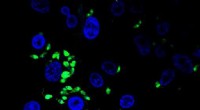
Here's why:
* Nucleus Composition: The nucleus is composed of DNA and proteins, which are rich in negatively charged phosphate groups.
* Stain Properties: Most common stains used for blood cell analysis are basic dyes, meaning they carry a positive charge.
* Electrostatic Attraction: Due to opposite charges, the positively charged dyes are strongly attracted to the negatively charged components of the nucleus, leading to a high concentration of stain within this area.
Therefore, the nucleus typically appears very dark or vibrant in color under a microscope after staining.
It's important to note that other parts of the blood cell, like the cytoplasm, can also be stained to a lesser extent, but the nucleus is the most prominent due to its high concentration of stainable material.