1. Monomers: The building blocks of proteins are amino acids. Each amino acid has a central carbon atom bonded to four groups:
- Amino group (NH2): Contains nitrogen.
- Carboxyl group (COOH): Contains a carbon double-bonded to an oxygen and single-bonded to a hydroxyl group.
- Hydrogen atom (H): Attached to the central carbon.
- R group (side chain): This is the variable group that differentiates one amino acid from another.
2. Dehydration Synthesis: The formation of a peptide bond between amino acids involves a dehydration reaction. In this process, a water molecule is removed as the carboxyl group of one amino acid reacts with the amino group of another amino acid. This reaction forms a peptide bond linking the two amino acids together.
3. Chain Growth: The polypeptide chain grows as more amino acids are added through dehydration reactions. This chain can be hundreds or even thousands of amino acids long.
4. Folding: The polypeptide chain then folds into a specific three-dimensional structure. This structure is determined by the sequence of amino acids and interactions between them. There are four levels of protein structure:
- Primary structure: The linear sequence of amino acids.
- Secondary structure: Regular, repeating patterns of folding, such as alpha-helices and beta-sheets.
- Tertiary structure: The overall three-dimensional shape of a single polypeptide chain.
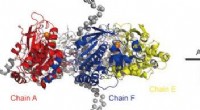
- Quaternary structure: The arrangement of multiple polypeptide chains in a protein complex.
In summary, proteins are formed through polymerization where amino acid monomers are linked together via peptide bonds formed through dehydration reactions. This process results in a long polypeptide chain that folds into a specific three-dimensional structure to form a functional protein.