Here's a more detailed description:
* Randomness: Cells won't move in any particular direction or with any set speed. They'll dart around in unpredictable patterns.
* Small, rapid movements: The movements are generally quite small and rapid, making the cells look like they're constantly vibrating or shaking.
* No clear pattern: There won't be any discernible flow or directionality to the movement. It's pure chaos, driven by the constant bombardment of water molecules.
* Continuous motion: As long as there are surrounding molecules, the cells will continue to jiggle and move.
Important Note: While Brownian motion can cause some movement in cells, it's typically not the primary factor driving their locomotion. Larger, more purposeful movements are usually driven by internal mechanisms like cilia, flagella, or cytoskeletal changes.
Visualizing Brownian Motion in Cells:
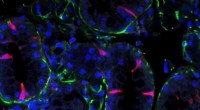
You can see this type of movement in cells under a microscope, especially when the cells are suspended in a liquid medium. This is a common demonstration in biology classes.
Here's an analogy:
Imagine a tiny dust particle caught in a whirlwind. The particle will be tossed around in all directions, moving erratically and seemingly at random. That's similar to how cells might appear under the influence of Brownian motion.