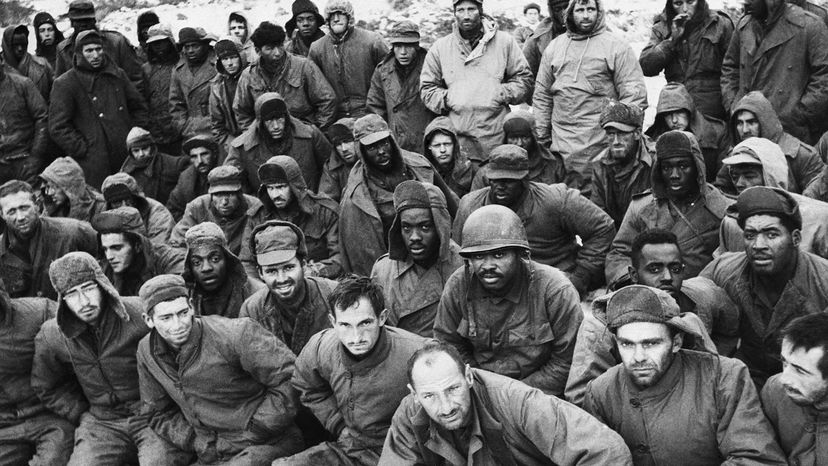
During the Korean War, Korean and Chinese captors reportedly brainwashed American POWs held in prison camps. Several prisoners ultimately confessed to waging germ warfare — which they hadn't — and pledged allegiance to communism by the end of their captivity. At least 21 soldiers refused to come back to the United States when they were set free. It sounds like a lot but skeptics point out that 22,000 POWs from communist countries refused repatriation versus only 21 American soldiers [source: Adams]. Does brainwashing really work in any reliable way?
In psychology, the study of brainwashing, often referred to as thought reform, falls into the sphere of "social influence." Social influence happens every minute of every day. It's the collection of ways in which people can change other people's attitudes, beliefs and behaviors. For instance, the compliance method aims to produce a change in a person's behavior and is not concerned with his attitudes or beliefs. It's the "Just do it" approach. Persuasion, on the other hand, aims for a change in attitude, or "Do it because it'll make you feel good/happy/healthy/successful." The education method (which is called the "propaganda method" when you don't believe in what's being taught) goes for the social-influence gold, trying to affect a change in the person's beliefs, along the lines of "Do it because you know it's the right thing to do." Brainwashing is a severe form of social influence that combines all of these approaches to cause changes in someone's way of thinking without that person's consent and often against his will [source: Working Psychology].
Because brainwashing is such an invasive form of influence, it requires the complete isolation and dependency of the subject, which is why you mostly hear of brainwashing occurring in prison camps or totalist cults. The agent (the brainwasher) must have complete control over the target (the brainwashee) so that sleeping, eating, using the bathroom and the fulfilling other basic human needs depends on the will of the agent. In the brainwashing process, the agent systematically breaks down the target's identity to the point that it falls apart. The agent then replaces it with another set of behaviors, attitudes and beliefs that work in the target's current environment [source: Britannica].
While most psychologists believe that brainwashing is possible under the right conditions, some see it as improbable or at least as a less severe form of influence than the media portrays it to be. Some definitions of brainwashing require the presence of the threat of physical harm, and under these definitions most extremist cults do not practice true brainwashing since they typically do not physically abuse recruits. Other definitions rely on "nonphysical coercion and control" as an equally effective means of asserting influence. Regardless of which definition you use, many experts believe that even under ideal brainwashing conditions, the effects of the process are most often short term — the brainwashing victim's old identity is not in fact eradicated by the process, but instead is in hiding, and once the "new identity" stops being reinforced the person's old attitudes and beliefs will start to return [source: Psychological Harassment Information Association].
There are psychologists who say the apparent conversion of American POWs during the Korean War was the result of plain-old torture, not "brainwashing." And in fact, most POWs in the Korean War were not converted to communism at all, which leads to the question of reliability: Is brainwashing a system that produces similar results across cultures and personality types, or does it hinge primarily on the target's susceptibility to influence? [source: Adams]. In the next section, we'll examine one expert's description of the brainwashing process and find out what makes an easy target.
Contents Singer R. Kelly arrives at the Leighton Criminal Courthouse on June 6, 2019, in Chicago. The singer appeared in court to face new charges of criminal sexual abuse. Several women accused him of brainwashing them into sexual servitude. Nuccio DiNuzzo/Getty Images
In the late 1950s, psychologist Robert Jay Lifton studied former prisoners of Korean War and Chinese war camps. He determined that they'd undergone a multistep process that began with attacks on the prisoner's sense of self and ended with what appeared to be a change in beliefs. Lifton ultimately defined a set of steps involved in the brainwashing cases he studied:
Each of these stages takes place in an environment of isolation, meaning all "normal" social reference points are unavailable, and mind-clouding techniques like sleep deprivation and malnutrition are typically part of the process. There is often the presence or constant threat of physical harm, which adds to the target's difficulty in thinking critically and independently [source : Changing Minds].
We can roughly divide the process Lifton identified into three stages: breaking down the self, introducing the possibility of salvation and rebuilding the self. Let's examine them in more detail:
First, the brainwasher shows leniency. With the target in a state of crisis, the agent offers some small kindness or reprieve from the abuse. He may offer the target a drink of water or take a moment to ask the target what he misses about home. In a state of breakdown resulting from an endless psychological attack, the small kindness seems huge and the target may experience a sense of relief and gratitude completely out of proportion to the offering, as if the agent has saved his life.
Next, the brainwasher offers an opportunity for confession. For the first time in the brainwashing process, the target is faced with the contrast between the guilt and pain of identity assault and the sudden relief of leniency. The target may feel a desire to reciprocate the kindness offered to him, and at this point, the agent may present the possibility of confession as a means to relieving guilt and pain.
Guilt is the real reason many subjects are in pain. After weeks or months of assault, confusion, breakdown and moments of leniency, the target's guilt has lost all meaning — he's not sure what he has done wrong, he just knows he is wrong. This creates something of a blank slate that lets the agent fill in the blanks: He can attach that guilt, that sense of "wrongness," to whatever he wants. The agent attaches the target's guilt to the belief system the agent is trying to replace. The target comes to believe it is his belief system that is the cause of his shame. The contrast between old and new has been established: The old belief system is associated with psychological (and usually physical) agony; and the new belief system is associated with the possibility of escaping that agony.
Next, releasing the guilt is a key step. The embattled target is relieved to learn there is an external cause of his wrongness, that it is not he himself who is inescapably bad — this means he can escape his wrongness by escaping the wrong belief system. All he has to do is denounce the people and institutions associated with that belief system, and he won't be in pain anymore. The target has the power to release himself from wrongness by confessing to acts associated with his old belief system. With his full confessions, the target has completed his psychological rejection of his former identity. It is now up to the agent to offer the target a new one [source: Singer].
Once those critical early stages of brainwashing are complete, it's time to move on to a more harmonious, if destructive relationship.
The subject is then presented with a path to alleged progress and harmony. In other words, "If you want, you can choose good." At this stage, the agent stops the abuse, offering the target physical comfort and mental calm in conjunction with the new belief system. The target is made to feel that it is he who must choose between old and new, giving the target the sense that his fate is in his own hands. The target has already denounced his old belief system in response to leniency and torment and making a "conscious choice" in favor of the contrasting belief system helps to further relieve his guilt: If he truly believes, then he really didn't betray anyone. The choice is not a difficult one: The new identity is safe and desirable because it is nothing like the one that led to his breakdown.
Next comes the final confession and rebirth: I choose good. Contrasting the agony of the old with the peacefulness of the new, the target chooses the new identity, clinging to it like a life preserver. He rejects his old belief system and pledges allegiance to the new one that is going to make his life better. At this final stage, there are often rituals or ceremonies to induct the converted target into his new community. This stage has been described by some brainwashing victims as a feeling of "rebirth" [source: Singer].
A brainwashing process like the one discussed above has not been tested in a modern laboratory setting, because it's damaging to the target and would therefore be an unethical scientific experiment. Lifton created this description from firsthand accounts of the techniques used by captors in the Korean War and other instances of "brainwashing" around the same time. Since Lifton and other psychologists have identified variations on what appears to be a distinct set of steps leading to a profound state of suggestibility, an interesting question is why some people end up brainwashed and others don't.
Certain personality traits of the brainwashing targets can determine the effectiveness of the process. People who commonly experience great self doubt, have a weak sense of identity, and show a tendency toward guilt and absolutism (black-and-white thinking) are more likely to be successfully brainwashed, while a strong sense of identity and self-confidence can make a target more resistant to brainwashing. Some accounts show that faith in a higher power can assist a target in mentally detaching from the process. People who've suffered abuse in childhood, have been exposed to eccentric family patterns and who have substance abuse issues are also more likely to be influenced [source: Curtis].
Mental detachment is one of the POW-survival techniques now taught to soldiers as part of their training. It involves the target psychologically removing himself from his actual surroundings through visualization, the constant repetition of a mantra and various other meditative techniques. The military also teaches soldiers about the methods used in brainwashing, because a target's knowledge of the process tends to make it less effective [source: Webb].
While the U.S. consciousness was turned to brainwashing in the 1950s in the aftermath of the Korean War, brainwashing has been around for longer than that. Scholars have traced the roots of systematic thought reform to the prison camps of communist Russia in the early 1900s, when political prisoners were routinely "re-educated" to the communist view of the world. But it was when the practice spread to China and the writings of Chairman Mao Tse-tung ("The Little Red Book") that the world started to take notice [source: Boissoneault].
 Patty Hearst is caught on a surveillance camera during a bank robbery in San Francisco. Bettmann/Getty Images
In 1929, Mao Zedong, who would later lead the Chinese Communist Party, used the phrase ssu-hsiang tou-cheng (translated as "thought struggle") to describe a process of brainwashing. Political prisoners in China and Korea were reportedly subjected to communist-conversion techniques as a matter of course. The modern concept and the term "brainwashing" was first used by journalist Edward Hunter in 1951 to describe what had happened to American POWs during the Korean War. Hunter introduced the concept at a time when Americans were already afraid: It was the Cold War, and America panicked at the idea of mass communist indoctrination through "brainwashing" — they might be converted and not even know it! [source: Boissoneault].
In the wake of the Korean War revelations, the U.S. government seemed to fear it was falling behind in the weapons race, because it began its own mind-control research. In 1953, the CIA began a program called MKULTRA. In one study, the CIA supposedly gave subjects (including the famed Timothy Leary) LSD in order to study the effects of mind-altering drugs and gauge the effectiveness of psychedelics at inducing a brainwashing-friendly state of mind. The results were not that encouraging, and subjects were supposedly harmed by the experiments. Drug experimentation by the CIA was officially cancelled by Congress in the 1970s, although some claim it still happens under the radar.
Public interest in brainwashing briefly subsided after the Cold War but resurfaced in the 1960s and 1970s with the emergence of countless non-mainstream political and religious movements during that era. Parents who were horrified by their children's new beliefs and activities were sure they'd been brainwashed by a "cult." The mass suicides and killing sprees committed by a small percentage of those cults seemed to validate the brainwashing fears, and some parents went so far as to have their children kidnapped by "deprogrammers" to remove them from the influence of cult leaders.
One supposed victim of brainwashing at that time was Patty Hearst, heiress to the Hearst publishing fortune, who would later use a brainwashing defense when she was on trial for bank robbery. Hearst became famous in the early 1970s after she was kidnapped by the Symbionese Liberation Army (the SLA, which some deem a "political cult") and ended up joining the group. Hearst reports that she was locked in a dark closet for several days after her kidnapping and was kept hungry, tired, brutalized and afraid for her life while SLA members bombarded her with their anti-capitalist political ideology. Within two months of her kidnapping, Patty had changed her name, issued a statement in which she referred to her family as the "pig-Hearsts" and appeared on a security tape robbing a bank with her kidnappers.
Patty Hearst stood trial for bank robbery in 1976, defended by the famous F. Lee Bailey. The defense claimed that Hearst was brainwashed by the SLA and would not have committed the crime otherwise. In her mental state, she could not tell right from wrong. Hearst was found guilty and sentenced to seven years in prison. She only served two — in 1979, President Carter commuted her sentence [source: Wilson].
More recently, in 2021, R&B singer R. Kelly was found guilty of sexual exploitation of a child, bribery, racketeering and sex trafficking involving five victims according to NPR. Parents of two young women as well as some of Kelly's inner circle said the singer brainwashed women and kept them in a cult where he controlled everything they did, according to BuzzFeed News.
There had been nearly 30 years of allegations of Kelly exploiting women, but in any case, "brainwashing" wasn't part of the list of things that he was charged with.
Fictional BrainwashingModern literature and film use the brainwashing scenario pretty liberally. It gets to the very nature of humanity: Are we all ultimately reducible to puppets? The protagonist in George Orwell's "1984" undergoes a classic case of brainwashing that ends with the famous concession to his tormentors: "two plus two equals five." In 1962's "The Manchurian Candidate," brainwashing produces a robot-like assassin incapable of overriding the control commands he's been programmed with. "A Clockwork Orange" (1971) positions institutional brainwashing as an option for violent convicts looking to shorten their sentences, and in 1997's "Conspiracy Theory," a mentally unstable, government-brainwashed assassin seeks to prove that some very powerful people have been tampering with his mind.
 John Lee Malvo, accused in the sniper shooting case, is shown at a motions hearing at Fairfax County Juvenile and Domestic Relations Court, Virginia. The Washington Post/Getty Images
Another "insanity by brainwashing" defense hit the courtroom in 2003, when Lee Boyd Malvo stood trial for his role in the 2002 sniper attacks in and around Washington, D.C. The 17-year-old Malvo and 42-year-old John Allen Muhammad shot 10 people and wounded three in a killing spree. The defense claimed that the teenaged Malvo was brainwashed by Muhammad into committing the crimes, which he would not have committed if he weren't under Muhammad's control. As Carlin Flora wrote in Psychology Today back in 2003:
"Muhammad plucked 15-year-old Malvo from the Caribbean island of Antigua, where his mother had abandoned him, and brought him to the U.S. in 2001. An army veteran, Muhammad filled the teen's head with visions of an impending race war and trained Malvo in marksmanship. He isolated Malvo, steeped him to his own idiosyncratic, vitriolic brand of Islam and imposed a strict diet and exercise regimen on his 'adopted' son."The argument was that Malvo was brainwashed, and because he was brainwashed he could not tell right from wrong, to the point that he laughed when describing the crimes.
"Brainwashing is not a legal term, and is probably shorthand for a 'lack of intention,'" said Richard Uviller, professor of law emeritus at Columbia University to Psychology Today at the time of the trial. "The defense has to show that at the time Malvo pulled the trigger, he did not intend to hurt the victims. Insanity defenses in general are rarely asserted and almost never prevail" [source: Flora].
Malvo was found guilty and sentenced to life in prison without parole in 2004. (Muhammad was sentenced to death in a separate trial) [sources: CNN]. Due to changes in sentencing laws for minors, Malvo may be eligible for parole after 20 years. Muhammad was executed in 2009 [source: Associated Press]. In the Malvo case, the jury didn't buy the "brainwashing" defense.
The future of brainwashing, if Hollywood and the conspiracy theorists are to be trusted, involves much more high-tech approaches, like say, implanting a chip in someone's brain. But most scientists agree that the field of neurology is nowhere close to that level of understanding of the human brain.
As the term "brainwashing" has now been around for decades, it is naturally facing an evolution of sorts. The term is thrown around pretty liberally, often used to describe the people immersed in controversial social systems, such as QAnon or the anti-vaxxer movement [source: Rodriguez]. However, many psychologists believe that using the term brainwashing to describe what's happening to these people is not accurate. This is because the true thought-reform process of brainwashing requires isolation and absolute dependence of the subject in order to be effective. By comparison, involvement in groups like QAnon is voluntary, and their success is often precipitated by the involvement of trusted friends, family members and other like-minded individuals [source: Lokere].
Instead, some scientists are gravitating toward the use of different terms to describe situations such as those, which are nonetheless hallmarked by big changes in attitude and actions. Coercion is one such alternative term, used to describe an incident where someone does something they don't really agree with because they feel threatened in some way. So, they don't necessarily align with the belief, but they have no choice but to follow suit. For example, the wife who goes along with QAnon conspiracy theories her husband spouts because it keeps the peace in her marriage.
Also, many people are not so much brainwashed as they are conditioned. If a person is repeatedly praised for certain behaviors and penalized for others he or she naturally gravitates toward the desired behavior. This is used all the time with training children or dogs to behave, but it's definitely not considered brainwashing under those circumstances!
Lastly, people who experience conversion to drastically different beliefs or emotions are usually inspired by a life-changing event, such as a near-miss accident, loss of a loved one or other major experience. So, no one is really forcibly telling the person what to do or how to behave, but they seek out other people with similar views to feel validated [source: Moore]. It's just not that easy to change a person's core personality and belief system, and the incorrect use of "brainwashing" can do quite the disservice.
HowStuffWorks earns a small affiliate commission when you purchase through links on our site.
Originally Published: May 10, 2006