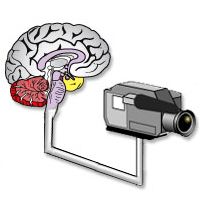
If you've ever made your own movie using a camcorder, you've probably noticed that the picture can be pretty shaky as you move from one image to the next. In all but the steadiest hands, there's an unstable transition between one focused object and the next. But for most of us, our eyes -- the video cameras of our brain, if you will -- suffer no unstable transition as they move quickly over a scene. The world remains stable no matter how quickly or erratically we change our focus.
Scientists have known about and even understood this phenomenon for decades. To achieve a stable view despite quick eye movements, the eyes do an amazing thing: They take before and after shots of every focused image and compare them in order to confirm stability. That sounds a little complicated, but the process itself is pretty straightforward (and ingenious): Before your eyes actually sense an object, your brain takes its own picture of that object for comparison purposes. It knows where your eyes are going to move next, and it forms an image of the object that precedes our conscious, visual perception of it. Then, when our eyes do perceive that object in a sensory way (meaning we can see it), our brain has already laid the framework for a smooth transition. There's no shakiness and no instability. The brain has anticipated what our eyes are going to see, and it uses that anticipatory image for comparison to make sure the world has indeed remained stable in the split-second between the before shot and the after shot.
So the process is in the books. But scientists have spent at least 50 years trying to find out how the brain manages this feat. A study published in the online edition of the journal Nature offers insight into the mechanism that lets our brain see what our eyes are going to see before our eyes even see it. Scientists believe they have found a neural pathway that may explain the brain's anticipation of our eye movements. (Neurons are the message carriers in the brain. They form pathways that carry signals from one part of the brain to another.)
Before we can understand exactly how this process works, we need to know a little about the various parts of the brain. Read on to learn more.

Before we get to the pathway itself, let's define a few of the major brain areas the study reports as being involved in conveying the information:

What the study discovered is a pathway between the motor cortex and the visual cortex that activates visual neurons before the eye itself actually moves. According to one of the study's authors, Marc Sommer of the University of Pittsburgh, a signal from the motor cortex tells the visual cortex to shift its focus to where the eye is planning to move next. This neural pathway starts in the midbrain, which has access to data from the motor cortex related to eye movement.
This data indicates what the eye is about to do next -- it's a copy of the signal the motor cortex is sending to the visual cortex to tell the eye to move. Neurons in the midbrain pass that information on to the thalamus, which sends the information to neurons in the visual cortex, telling them to shift their "perception window" to match the upcoming command. The new, unperceived image from the shifted window arrives at the somatic sensory cortex, where it is soon joined by the visual image perceived by that same shift a moment later. When the somatic sensory cortex interprets the visual signal coming in from the primary visual cortex, it compares it to the prior view of the same scene. As long as both views are the same, it interprets "stability" and simply filters out any shakiness in the transition from one visual image to another.
The study's authors expect this finding to lead to further understanding of other uninterrupted sensory transitions, such as the constant perception of sound that occurs even as you turn your head in different directions.
For more information on the brain and sensory perception, take a look at the links on the next page.
HealthAllergy BasicsNothing to Sneeze at: Allergies May Affect the BrainHealthBrain & Central Nervous SystemWhat is the extrasensory brain?HealthBrain & Central Nervous SystemCan brain foods make you smarter?HealthBrain & Central Nervous SystemTest Your BrainHealthBrain & Central Nervous SystemThe Brain and Mental HealthHealthBrain & Central Nervous SystemThe Brain and Nervous System: The Body's Command CenterHealthBrain & Central Nervous SystemAre teensâ brains fully developed?HealthBrain & Central Nervous SystemBrain Teasers and Mind GamesHealthBrain & Central Nervous SystemScientists Discover Your Brain Makes FructoseHealthBrain & Central Nervous System5 Things You Didnât Know About Donating Your Brain to ScienceHealthBrain & Central Nervous SystemBrain and Central Nervous SystemHealthBrain & Central Nervous SystemThe Cerebellum Is the Body's Little BrainHealthBrain & Central Nervous SystemHow 'Savant Syndrome' Makes Some People, and Their Brains, ExtraordinaryHealthDreamsHow does the brain transform reality into dreams?HealthDrugs & AlcoholWeed Enthusiast Arrested for Keeping Human Brain Under His PorchHealthFitness InformationMind Games: Creating New Brain CellsHealthHuman BehaviorIntrovert and Extrovert Brains Aren't the SameHealthInfant HealthFemale Newborns May Fare Better After Some Brain InjuriesHealthNeurological ConditionsQuestions to Ask Brain SpecialistsHealthNeurological ConditionsWhen Wisecracks and Puns Are Symptoms of Brain DamageHealthNeurological ConditionsAgitation and Depression in Patients with Brain DiseaseHealthNeurological ConditionsTotally Tone-deaf? The Problem Is in Your Brain, Not Your EarsHealthModern Medical TreatmentsGroovy News: Shrooms Help Reset Depressed BrainHealthPreventive CareHow to Prevent Brain InfectionsHealthRespiratory ConditionsDoes altitude sickness cause brain swelling?HealthSenior Health & LifestyleDon't Forget -- Give Your Brain a Workout, TooHealthStress ManagementEffect of Stress on the BrainHealthStress ManagementIsolation and Monotony Stress the Brain. Here's How to CopeHealthTeenage HealthCertain Adolescent Brains Can't Stop Gaming. That's Good and Bad â Here's WhyHealthWeight LossIs a Hormone in Our Brains the Key to Burning Fat? HealthWomen's General HealthWomen's Brains Harder Hit by AlcoholScienceBiological FieldsHow Does a Slime Mold Make Decisions Without a Brain?ScienceEmotionsIs morality located in the brain?ScienceEmotionsIs emotional intelligence a better indicator of brain health than IQ?ScienceEveryday MythsCan our brains see the fourth dimension?ScienceEvolutionDid Schizophrenia Evolve Along With Our Brains?ScienceThe Human BrainHow Your Brain WorksScienceThe Human BrainHow Brain Death WorksScienceThe Human BrainHow Brain Mapping WorksScienceThe Human BrainAre teenage brains really different from adult brains?ScienceThe Human BrainWhy are people's brains different sizes?ScienceThe Human BrainIs the human brain still evolving?ScienceThe Human BrainIs my brain making me buy things I don't need?ScienceThe Human BrainHow Albert Einstein's Brain WorkedScienceThe Human BrainIs the brain hardwired for religion?ScienceThe Human BrainDoes Your Brain Get Tired Like the Rest of Your Body?ScienceThe Human BrainCan brain damage lead to extraordinary art?ScienceThe Human BrainHow Deep Brain Stimulation WorksScienceThe Human BrainIs the computer a good model for the brain?ScienceThe Human BrainCould a brain scan tell you if you're going to become a criminal?ScienceThe Human BrainAre you really only using 10 percent of your brain?ScienceThe Human BrainDo men and women have different brains?ScienceThe Human BrainNeanderthals Had Bigger Brains Than Modern Humans â Why Are We Smarter?ScienceThe Human BrainThe Human Brain Is Hardwired for PoetryScienceThe Human BrainUnderstand? Your Brain Signals Will TellScienceThe Human BrainYes, Conspiracy Theoristsâ Brains Really Are DifferentScienceThe Human BrainCan your brain have a traffic jam?ScienceThe Human BrainRelying on GPS Prevents Parts of Your Brain From ActivatingScienceThe Human Brain'Aleppo Moments': What Causes Our Brains to Freeze Under Pressure?ScienceThe Human BrainThe Human BrainScienceThe Human BrainHow Brainwashing WorksScienceThe Human BrainHow does your brain impact your survival chances in the wilderness?ScienceThe Human BrainBinaural Beats: Does This Auditory Illusion Really Calm Your Brain?ScienceThe Human BrainHow does the brain create an uninterrupted view of the world?EntertainmentBrain GamesHow Lumosity Brain Games WorkEntertainmentBrain GamesDoes juggling exercise your brain?EntertainmentBrain GamesBrain Games