Sleepwalking is an intriguing phenomenon. The fact that you're sleeping while performing physical feats is pretty amazing. How can a person be unconscious but still coordinate his or her limbs in order to walk, talk and, sometimes, even drive? How do we know when we're really awake?
Doctor: You see, her eyes are open. Gentlewoman: Ay, but their sense is shut. - Macbeth, Act V Scene 1Sleepwalking is also known as somnambulism, so add that to your SAT vocab. It's classified as a parasomnia, an abnormal behavior during sleep that's disruptive. Common parasomnias include bed-wetting and teeth grinding. Drs. Hobson and Silvestri describe parasomnias as "errors in timing and balance" in the brain as it transitions between waking and sleeping [source: Hobson].
Think of how complex the brain is and how many tasks it performs: It keeps you breathing, it reminds your heart to beat, it records all the memories of your life, and it enables you to laugh, cry, love and converse. Now think of how you sleep, how your body moves from dreams to no dreams and back again, how you might steal covers from your partner or snore or move around, how sometimes you wake up rested and other days you wake up anxious. It's a complex process controlled by a complex organ: There's plenty of room for glitches.
What makes a sleeping body rise? People used to think that sleepwalkers were acting out their dreams and subconscious desires and fears. Take Shakespeare's Lady Macbeth, who during the day conceals the depth of her treachery, but at night in her sleep confesses her guilt. Others associate it with the occult, as in "Dracula" when the vampire is finally able to sink his teeth into Lucy while she sleeps. Others insist that it's purely a physical response, illustrated by the case of the title character in Bellini's opera "La Sonnambula," who incurs all sorts of trouble by the innocent actions she performs while she sleeps (more on this later).
In this article, we'll explore the whys of sleepwalking: why it happens the way it does, why it happens at all and why it's so fascinating.
Contents An image is projected onto the facade of the Museum of Modern Art during a public art project by artist Doug Aitken in New York City. "Sleepwalkers" explored how people experience memory and narrative in an urban environment.
Spencer Platt/Getty Images
An image is projected onto the facade of the Museum of Modern Art during a public art project by artist Doug Aitken in New York City. "Sleepwalkers" explored how people experience memory and narrative in an urban environment.
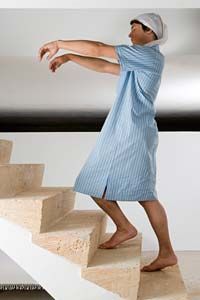
Spencer Platt/Getty ImagesYou've probably seen sleepwalkers in the movies traveling down staircases with eyes shut and arms outstretched, but let's learn the facts.
The DSM-IV, a handbook for mental health professionals, defines sleepwalking by these criteria:
[source: Szelenberger]
Now let's take a look at some of these criteria. During the first third of the night, your body is in NREM (non-REM) -- your deepest stage of sleep. NREM sleep is when you tend to toss and turn in bed. Your brain quiets down, which means that you aren't dreaming. So sleepwalkers aren't acting out their dreams. Think of it this way: In NREM sleep, your brain isn't very active, but your body is. In REM sleep, your brain is very active while your body isn't.
The brain is resistant to arousal during deep sleep, which explains why it's difficult to wake a sleepwalker. And if you do manage to wake one up, the sleepwalker is likely to exhibit signs of confusion for several minutes and have little to no memory of anything that happened.
Sleepwalking episodes can last from a few seconds to half an hour. Sleepwalkers usually have glassy-looking eyes and blank expressions on their faces. They might look awake but act clumsy. Sleepwalkers are capable of performing a variety of activities, from simply getting up and walking around the room to driving a car or playing an instrument.
 Sleepwalking occurs most often in children, and more commonly in boys than in girls.
Sarma Ozols/Getty Images
Sleepwalking occurs most often in children, and more commonly in boys than in girls.
Sarma Ozols/Getty ImagesSleepwalkers are most often children. Lots more people than you realize have stories about sleepwalking when they were kids -- their parents found them wandering on the front lawn, or they walked down the street in their pajamas. Kids tend to grow out of it. The adult population of sleepwalkers is much smaller. Sleepwalking also runs in families, and occurs more often in boys than in girls.
So now to the million-dollar question: Why do some of us get up and walk around in the middle of the night?
Should you wake a sleepwalker?The idea that you shouldn't wake a sleepwalker up is a myth, but it's probably also a bad idea to startle him or her. Sleepwalking can be dangerous -- a child could fall, or an adult could get in a car and try to drive somewhere. The best idea is to gently guide the sleepwalker back to bed. Most people only have one sleepwalking episode a night, so the person is unlikely to rise again [source: Chan].
 Sleep stages
People used to think that sleepwalkers acted out their dreams. They also thought that sleepwalking had to do with epilepsy, hysteria, dissociative disorders or even your own secret wishes.
To be perfectly honest, no one knows exactly why people sleepwalk, but we'll talk about some possibilities.
We've mentioned that sleepwalking occurs during your deepest stages of sleep, stages 3 and 4, when brainwaves are very slow. During the day, your brain is a beehive of activity -- during NREM sleep it is barely humming. Your body, however, is still active, and hasn't completely quieted down for the day. So what we have here is a body that can still move, paired with a sleepy brain.
Mental health professionals refer to sleepwalking as a "disorder of arousal," which means that something triggers the brain into arousal from deep sleep, so the person is in a transition state between sleeping and waking.
The fact that most sleepwalkers are children is significant, especially since most of them grow out of it. A child's brain develops very quickly and is primed to soak up all kinds of stimuli. Drooling babies grow into reading kindergarteners in five years -- do you think you'll experience the same kind of brain development in the next five years?
Some suggest that a child's brain is simply too immature to completely understand the cycles of waking and sleeping -- think of sleep as having fuzzy borders. Other propose that since children develop so quickly, perhaps some areas of the brain outpace others in development, or certain aspects of development take precedence.
NREM sleep is also when your body repairs itself and releases hormones, including growth hormones. Children spend a lot of their time growing, and it's possible that the release of hormones has something to do with triggering arousal from sleep.
Most adult sleepwalkers also sleepwalked as children -- it rarely begins in adulthood except as a symptom of another disorder. Children tend to sleepwalk more when they are overly tired or stressed. The same factors affect adults, as well as certain medicines, alcohol and fever illnesses.
Of course, in some people, sleepwalking isn't so harmless. Sleepwalking has been linked to seizures, REM sleep disorders and organic brain disorders like Parkinson's and Alzheimer's. If your child is sleepwalking, he or she will probably either grow out of it or can be helped by a regular sleep schedule and some stress reduction. If you're an adult and start sleepwalking, it might be a good idea to talk to a doctor.
Sleepwalking MurderersSome sleepwalkers go beyond just wandering around their house in a nightshirt. A man in Manchester named Jules Lowe murdered his father while sleepwalking and was acquitted. Scott Falater, an Arizona resident, claimed the sleepwalking defense after he was accused of stabbing his wife 44 times — he was found guilty. But these aren't isolated cases. Psychiatrist Peter Fenwick reports cases of sleepwalking murderers going back to the year 1600, when a knight stabbed his friend to death and was found guilty [source: Fenwick]. The earliest mention of someone being acquitted of murder on the grounds of sleepwalking in the United States appears to be that of Albert Tirrell, who was accused of murdering his lover in 1846.
 Circa 1865: Italian-born British operatic soprano Adelina Patti in the opera "La Sonnambula"
Hulton Archive/Getty Images
Circa 1865: Italian-born British operatic soprano Adelina Patti in the opera "La Sonnambula"
Hulton Archive/Getty ImagesSleepwalking is a popular phenomenon to depict within the arts, possibly because it's a way to explore boundaries and convey psychological elements. Shakespeare, for one, used a sleepwalking scene in "Macbeth" to expose a key element in Lady Macbeth's character development. Her ruthless ambition leads her to concoct a murder plot -- only it turns out that she doesn't have the stomach for it. Her gentlewoman brings a doctor to see Lady Macbeth as she walks the castle in her sleep, confessing her sins and attempting to wash the blood from her hands. Sleep takes away the mask she wears during the day and calls forth her confessions without her permission -- the sleeping body rebels against the waking mind.
In Bellini's opera "La Sonnambula," a sleepwalking incident leads to chaos. A sleepwalking woman is accused of being unfaithful to her husband when she innocently awakens in another man's room. In the opera, the other characters only believe the sleepwalker's story when they see her walking along a high bridge. They don't wake her because the shock might cause her to fall and perish. Her innocence is proven only by her proximity to danger. This is the sort of instance that maybe gave rise to the myth that waking a sleepwalker is harmful.
 1958: Nina Vyroubova and Serge Golovine in "The Sleepwalker," by International Ballet of theMarquees de Cuevas
Lipnitzki/Roger Viollet/Getty Images
1958: Nina Vyroubova and Serge Golovine in "The Sleepwalker," by International Ballet of theMarquees de Cuevas
Lipnitzki/Roger Viollet/Getty ImagesLegendary choreographer George Balanchine's ballet "La Sonnambula" uses some of Bellini's music, but changes the story. The ballet tells the tale of a poet who attends a baron's ball, meets a beautiful sleepwalker and is murdered by the host of the ball in a fit of jealousy. When the poet encounters the sleepwalker, he can't wake her. After he dies, his body is brought to her to hold. It's interesting to see a ballet that involves sleepwalking, the physical aspect of the sleepwalking is the most important. The ballerina dancing the part of the sleepwalker must perform a complicated pas de deux while making it clear to the audience that she's asleep. The element of sleepwalking adds an eerie, mystical feeling that enhances the darker undertones of the ballet.
A scene from the German silent film "The Cabinet of Dr. Caligari," directed by Robert Wiene
Hulton Archive/Getty Images"The Cabinet of Dr. Caligari" is possibly the world's first horror movie, and its plot centers on the idea of a murdering sleepwalker controlled by an evil doctor. The film's German Expressionist style helps set the tone for madness and sinister forces, with dramatic shadows and warped-looking sets. In "Dracula," the vampire is finally able to sink his teeth into Lucy during a bout of sleepwalking.
In the arts, sleepwalking is linked to blood, danger and the occult, but most of all, loss of control. Sleepwalkers cede their fate to the hands of those around them. Part of the fascination with sleepwalking might be because it involves a state of transition, a person with his or her feet in two different spheres, straddling the border. Part of it is also fear -- what fantasies or dark deeds might you act in your sleep, unbeknownst to yourself? What if your body roams the night, but leaves its soul and mind behind? Sleepwalking has a zombie-like component to it.
 Sleep-eating is one side effect of Ambien.
© Blasius Erlinger/Getty Images
Sleep-eating is one side effect of Ambien.
© Blasius Erlinger/Getty ImagesSleepwalking isn't the only parasomnia. There's also sleepsex, sometimes called sexsomnia or SBS (somnambulistic sexual behavior). It's pretty much what it sounds like -- sexual behavior during sleep. People with this condition might touch themselves sexually or initiate sex while asleep. They only know it happened when their roommate or partner mentions the incident. One man was actually acquitted of rape after using the defense that he was asleep at the time of the assault [source: The Independent]. People with sexsomnia tend to be sleepwalkers or have other parasomnias.
Just as disconcerting? Sleep-eating. You might associate sleep eating with the sleep aid Ambien. As the drug grew in popularity, stories began to crop up about people eating in their sleep. And not just getting up for a sandwich -- eating from tubs of margarine or eating cigarettes and raw meat. People wake up with crumbs in the bed or start putting on the pounds and have no idea why. They might come into the kitchen only to find tortilla chips all over the counters and cheese on the floor -- sloppy preparation seems to be a hallmark of sleep-eating. Ambien outsells all other RX sleep aids in its class, despite the possible strange side effects [source: NY Times]. Some people report that the problem stops after they switch to another drug, and that Ambien itself is the problem. Some doctors say that sleep-eating might just be another symptom of whatever's causing your sleepwalking in the first place.
Some people clench or grind their teeth while they sleep, a condition called bruxism. The grinding noise can be loud enough to wake up your sleeping partner -- some people say it sounds like the person is chewing rocks. It can damage the teeth, give you headaches and make your jaw hurt. If you're awake and grinding your teeth, you'll notice when it starts to hurt and you'll stop, but when you're asleep, the body isn't as attuned. One doctor claims that sleep bruxism results in 250 lbs. of pressure on the tooth [source: NY Times]. Stress makes bruxism worse, and some doctors recomment anti-anxiety medications for strong cases, although a special mouthguard should help.
 Sleep bruxism could result in 250 lbs. of pressure on the tooth.
Holloway/Getty Images
Sleep bruxism could result in 250 lbs. of pressure on the tooth.
Holloway/Getty ImagesSleep talking, sometimes called somniloquy, might wake up the person next to you, but it's harmless. Someone who sleep talks might just make noises, or could have a long one-sided conversation with you. Sleep enuresis is a fancy term for bed-wetting. REM sleep behavior disorder (RBD) is a bit like sleepwalking, only someone with RBD is acting out during REM sleep, the stage where your muscles shouldn't be moving at all. RBD usually results in people acting out their dreams, like the false perception people have of sleepwalking.
For more information on sleep and sleep disorders, there are links on the next page that might interest you.
ScienceThe Human BrainHow Sleep WorksScienceThe Human BrainHow Polyphasic Sleep WorksScienceEmotionsCan sleep make me happy?ScienceThe Human BrainHow Sleep Labs WorkScienceThe Human BrainIs a lack of sleep making me fat?ScienceSpaceflightWhat is it like to sleep in space?ScienceThe Human BrainIs science phasing out sleep?ScienceEveryday MythsDoes the full moon affect your sleep?ScienceThe Human BrainCan sleeping with a concussion kill you?ScienceThe Human BrainWhy are demons blamed for sleep paralysis?ScienceThe Human BrainHow Sleepwalking WorksScienceThe Human BrainAmbienScienceEveryday InnovationsWho invented the sleeper sofa?HealthDiabetesSleepHealthAging ProcessHow do my sleep habits change as I age?HealthSleep BasicsCan melatonin help you sleep better?HealthSleep BasicsSleep PicturesHealthSleep JournalSleep ScheduleHealthSleep DisordersDangers of Sleep ApneaHealthSleep JournalSleep DeprivationHealthSleep DisordersDo you need sleep drugs?HealthSleep BasicsThe Get Better Sleep QuizHealthSleep DisordersHow Sleep Deprivation WorksHealthSleep JournalI Can't Sleep Because I'm Worried About Not SleepingHealthSleep BasicsIs sleep that important?HealthSleep BasicsAvoiding Sleep DeprivationHealthSleep JournalSleep and SmokingHealthSleep JournalSleep and AgingHealthAlternative MedicineNatural Sleep AidsHealthSweating and OdorSweating While SleepingHealthBaby CareBaby Won't Sleep? 5 Tips From a Baby Sleep CoachHealthModern Medical TreatmentsSleep Apnea TreatmentsHealthSleep BasicsHow Sleep Consolidates Our MemoriesHealthSleep BasicsHow are sleep and heart disease related?HealthSleep BasicsWhy do we sleep?HealthTeenage HealthHelping Sleep-deprived TeensHealthSkin Cleansing TipsIs it bad to sleep with my makeup on?HealthOsteoarthritisHow does sleep affect osteoarthritis?HealthSleep BasicsWill you die if you never sleep?HealthSleep DisordersDoes sleep deprivation lead to risky decisions?HealthSleep BasicsWhat Happens When We Sleep?HealthSleep JournalCreating the Right Sleep EnvironmentHealthSleep Basics5 Effects of Sleep DeprivationHealthSleep Disorders9 Most Common Sleep DisordersHealthSleep JournalSleep In the Modern WorldHealthBaby CareSafe Sleeping For Your BabyHealthSleep DisordersWhy Some People Can't Sleep Without a FanHealthSleep BasicsWhy Socks Help You Sleep BetterHealthSleep BasicsDo Weighted Blankets Help With Sleep?HealthBaby CareMore Babies Are Sleeping in Boxes â and That's a Good ThingHealthSleep BasicsWill we learn to live without sleep?HealthSleep DisordersDoes Sleeping On Your Side Stop Snoring?HealthHeadacheHow do my sleep and rest patterns affect my headaches?HealthSleep DisordersHow Do You Sleep When Sailing Solo for 4,000 Miles?HealthSleep BasicsCan Military Meditation Techniques Help You Fall Asleep Fast?HealthSleep JournalMany of My Sleep Problems Are Due to Bad HabitsHealthSleep Basics5 Health Risks of Too Little SleepHealthSleep BasicsCan you die if you donât sleep?HealthSleep Disorders10 Signs You May Be Sleep DeprivedHealthSleep BasicsYes, You Can Catch Up On Your Sleep!HealthSleep DisordersWhy Are You So Tired? 5 Most Common Sleep MistakesHealthWeight LossWhy do I lose weight while I sleep?HealthGERDHow do sleep and rest patterns affect GERD?HealthSleep BasicsHow many hours of sleep do you really need?HealthSleep BasicsOne Simple Way to Get More Sleep: Lower the ThermostatHealthSleep BasicsHow to Fall AsleepHealthSleep JournalTime For a New Mattress?HealthSleep JournalSecrets of the Siesta and High-Tech MattressesHealthSleep DisordersCan You Fall Asleep With Your Eyes Open?HealthSleep DisordersWhy Do People Fall Asleep in Movie Theaters?AnimalsAnimal FactsDo all creatures sleep?AnimalsAquatic MammalsHow do walruses sleep in the water without drowning?AnimalsCorals & JelliesJellyfish Don't Have Brains, But They Still SleepAnimalsDog CareHow to Help Puppies SleepAnimalsAquatic MammalsDolphins Sleep Half a Brain at a TimeAnimalsFamily DogsPeople Sleep More Soundly With Their Dogs in the Bedroom ... With One ExceptionAnimalsAquatic MammalsDo whales and dolphins sleep?LifestyleTweens and TeensWhat do you do if your teen can't sleep?LifestyleParenting TipsHow can a new mom get more sleep?LifestyleBack to School5 Things You Should Know: Teens and SleepLifestyleParenting TipsHow to Help a Child Who Is Having Trouble Falling AsleepLifestyleParenting TipsCan Scented Pillow Inserts Help You Sleep Better?ElectronicsAutomotive GadgetsHow Anti-sleep Alarms WorkElectronicsOther GadgetsDoes wearable tech really help people sleep better?ElectronicsTech's Effects on the FamilyIs your children's computer time affecting their sleep patterns?PeopleFolklore & SuperstitionWill sleeping with a fan on kill you?PeopleLearningDoes sleeping after learning make you smarter?PeopleSchoolingHigh Schools Are Allowing Sleep-deprived Students to Take Midday NapsAdventureHiking & CampingSpend a Weekend Camping to Sleep Better, Study SaysAutoSafety & Regulatory DevicesWill your next car wake you up when you fall asleep at the wheel