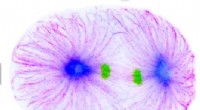
1. Centrosomes: These organelles serve as the primary microtubule organizing centers in animal cells. During mitosis, the centrosomes duplicate and separate to opposite poles of the cell, forming the spindle poles.
2. Spindle fibers (microtubules): The spindle fibers are composed of microtubules, which are responsible for capturing the chromosomes and moving them during mitosis. These fibers extend from the spindle poles and interact with the kinetochores on the chromosomes.
3. Kinetochores: Kinetochores are protein complexes that form where the spindle fibers attach to the chromosomes. They are located on the centromere region of each chromosome and ensure proper chromosome segregation during mitosis.
4. Cleavage furrow: In animal cells, when mitosis is completed, the cytoplasm divides by a process called cytokinesis. The cleavage furrow is a structure that forms at the equator of the cell, pinches inward due to the contraction of a contractile ring composed of actin and myosin filaments, eventually dividing the cell into two separate daughter cells.