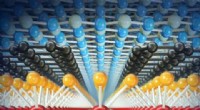
The plasma or cell membrane is the outermost layer of animal and plant cells. Prokaryotic cells do not have a cell membrane. They have a cell wall instead. The plasma membrane is made up of a double layer of phospholipids (a phospholipid bilayer) forming a “fluid mosaic”. Each phospholipid molecule consists of a glycerol backbone and two fatty acids. The fatty acids can be either saturated or unsaturated. Saturated fatty acids have no double bonds between carbon atoms, while unsaturated fatty acids have one or more double bonds between carbon atoms.
Structure of a Cell Membrane
Phospholipids are arranged such that the two layers of fatty acid “tails” face each other and the two layers of phosphate-containing “heads” face outward interacting with the water environment both inside and outside the cell. Cholesterol is also found within the cell membrane and contributes to its elasticity and rigidity.
Carbohydrates are on the outside of the membrane and face outward. They contribute to cell recognition and attachment. Membrane proteins have 2 main classifications:
- Integral proteins are completely buried within the membrane bilayer.
- Peripheral proteins are not embedded in the membrane but are attached to the surface of the membrane.
These proteins function as either channels or transporters of substances into and out of the cell.
Properties of the Cell Membrane
The plasma membrane is selectively or semipermeable. Substances that are not soluble in fat cannot cross the membrane, while substances that are soluble in fat can move through the membrane freely. Thus the cell membrane is somewhat of a lipid barrier protecting the cell. Membrane proteins regulate passage in and out of the cell. Many proteins also act as enzymes to speed chemical reactions taking place in the cell.
The cell membrane is not static. Proteins and phospholipids can move about creating a fluid cell membrane. This means the membrane is elastic. However because of the fatty acids in the phospholipid, there are constraints to the membrane movement, it is not fluid like oil.
The plasma membrane protects the cell from its environment. It controls the movement of substances into and out of the cell. The plasma membrane also communicates with neighboring cells.